

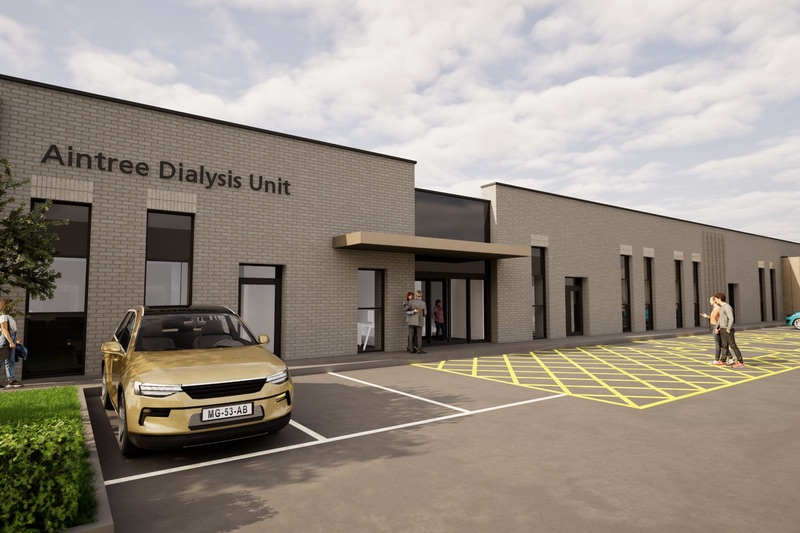
Construction work has started on a new £5m dialysis centre at Aintree University Hospital.
The new centre should significantly improve access to the service for patients across Liverpool, replacing the current Aintree clinic and Waterloo unit.
The Hospital also had recent investment in its A&E, completing an extension in late 2023.
This new dialysis centre will have capacity for around 160 patients, approximately 42% more than the current Aintree clinic, enabling more people to access dialysis and better care in a modern facility.
The development, which is being delivered in partnership with Fresenius Medical Care, is expected to complete in Summer 2027, with the first patients expected to receive treatment from July.
In addition to increasing the number of dialysis stations from 19 to 27, there will be a dedicated six-station home dialysis training facility, alongside shared-care and self-care areas. These facilities will help patients better understand their treatment, build confidence in managing aspects of their care and, where appropriate, support a transition to dialysing at home.
The new purpose-built centre at Aintree will also become the first net zero dialysis centre in the UK.
Environmental impact of dialysis
Dialysis is an essential, regular treatment, but it is also highly resource- and energy-intensive.
Sandycroft, the contractors on the project, say that the new build is expected to be the first net zero dialysis centre in the UK, in what is a particularly resource- and energy-intensive field of medical work.
The new development addresses a national challenge of modernising facilities needed for essential treatment while reducing their environmental impact, and it aims to set the benchmark for the buildings that support dialysis care in the UK.
"Our project design includes enhanced insulation to the whole structure, air-source heat pumps, LED lighting, smart ventilation controls and approximately 79kW of rooftop solar panels," Sandycroft stated.
Dr Andy Nicolson, Group Chief Medical Officer at NHS University Hospitals of Liverpool Group, said: “This is great news for our patients. People who rely on regular dialysis spend a lot of time in treatment, so the environment they receive care in really matters, and I’m delighted that work has now started on a new centre that will improve the experience of dialysis for the communities we serve.
“Local patients are at the heart of this project, but its significance is national. Together with Fresenius Medical Care, we want Liverpool to show how modern patient facilities and lower-carbon design can go hand in hand. This is about building for our communities today and helping shape the NHS of tomorrow.”
We want Liverpool to show how modern patient facilities and lower-carbon design can go hand in hand
Patients have been engaged in the development of plans for the centre, which has been designed with their comfort and convenience in mind, bringing in extensive natural light to support wellbeing and providing a central location with dedicated patient parking, including EV charging.
It will feature enhanced insulation, air-source heat pumps, LED lighting, smart ventilation controls and approximately 75kW of rooftop solar capacity. Together, these measures are designed to minimise the building’s operational carbon footprint and help support the NHS net zero agenda of reaching net zero by 2045.
Jonathon Lawrence, Managing Director UK & Ireland at Fresenius Medical Care, said: “Dialysis is essential. Reducing the environmental impact of the buildings that support it must be a priority too. This centre puts lower-carbon design at the heart of kidney care infrastructure.
“We are always striving to improve the care we provide to patients and where possible, reduce our environmental impact. This centre is a great example of that in practice and we hope it can show what is possible for renal care across the UK.”
Top image: An artist's rendering of the dialysis centre Image credit: NHS University Hospitals of Liverpool Group


