

At a quiet corner of London’s biomedical research landscape, a small team is shaping the future of healthcare.
The Q-BIOMED Hub, the UK’s only research centre dedicated exclusively to clinical quantum sensing, is translating physics once confined to university labs into tools that could fundamentally change disease detection and treatment.
“If you were to mention quantum sensing to most people, they would likely imagine it as a technology of the future,” says Sheena Visram, Principal Advisor at the hub. “But the science has already found its footing and is evolving from theory into tangible products that are subtly shaping our world today.”
Nano-diamonds for COVID-19 and HIV diagnosis
Among Q-BIOMED’s most promising applications is the use of nano-diamonds for ultra-sensitive diagnostics.
Pioneered by principal investigator Ben Miller, the technology exploits the quantum properties of diamonds to detect biological markers, or signals in the body that indicate the presence of a disease or infection, with unprecedented sensitivity.
“Instead of using the diamonds simply as sensors, we deliberately manipulate their ‘spin states’ and measure how they evolve over time,” Miller explains.
“This is important because by flipping specific spin transitions and reading the emission of light, we detect extremely small quantities of disease markers.”
Tests under development include HIV diagnostics via a finger-prick and COVID-19 antigen detection using swabs and wastewater.
Designed for point-of-care settings, these tests bring lab-level sensitivity into homes, pharmacies, clinics and neighbourhoods.
“We’re aiming to fill the gap between standard lateral flow tests and more sensitive laboratory techniques called PCRs,” Miller says. “The goal is to achieve the sensitivity of lab tests at the point where we are delivering care.”
Miller’s research, published in October in Nature Communications, suggests spin-enhanced nanodiamond lateral flow tests can identify infections up to two days earlier than conventional methods.
With further engineering for portable formats, quantum-enabled diagnostics could move from research labs to primary care.
Quantum-enabled brain imaging for epilepsy
Neurological monitoring, particularly for epilepsy, is another frontier.
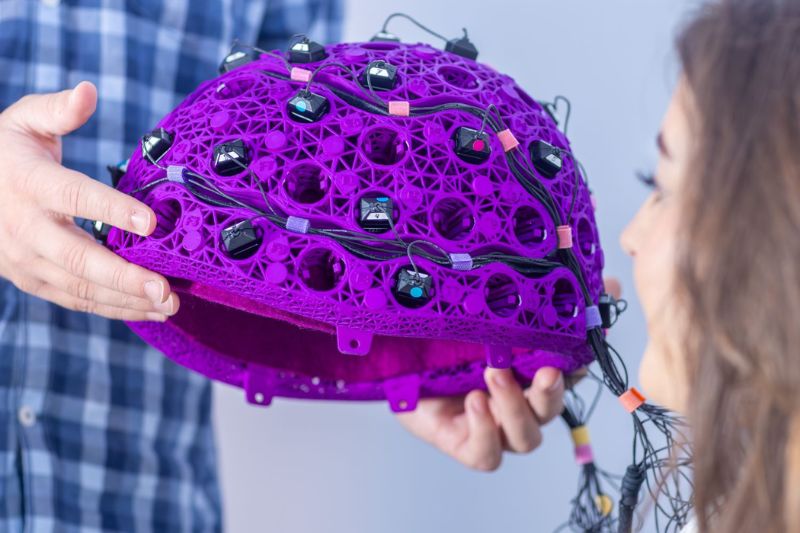
Wearable magnetometers developed by Cerca Magnetics capture neural activity in real time, promising more accurate diagnostics and improved monitoring for children and adults.
“Wearable MEG sensors, designed to image the brain, could transform patient outcomes by providing insights into conditions ranging from epilepsy to concussion,” says Matthew Brookes, Director and Chairman of Cerca Magnetics and Professor of Physics at the University of Nottingham.
Epilepsy affects around 600,000 people in the UK, and for about 200,000 of them, seizures cannot be controlled by drugs.
For some, surgery offers a cure, but only if surgeons can pinpoint where seizures begin.
Traditional MRI scans provide structural images and cannot capture the rapid changes in brain activity associated with seizures.
Cerca’s MEG directly measures the magnetic fields generated by neuronal electrical activity, allowing doctors to see seizure activity in real time.
“MRI by itself doesn’t work as it doesn’t show the abnormalities. What we’ve built can find those abnormal regions."
For epilepsy, the technology already works; now we need to get it into hospitals,” Brookes says.
Validation is underway in NHS clinical research trials, with plans for integration into clinical workflows.
The same scanners could one day help detect early dementia or assess concussion on rugby pitches and military training grounds, where early brain damage often goes unseen.
Entangled camera for breast cancer diagnosis
For decades, diagnosing breast cancer has relied on an analogue process: tissue samples are removed, stained, and visually assessed.
Results guide chemotherapy decisions, but interpretations can vary, leading to over-treatment.
UK-based company Digistain is tackling this gap with a quantum-enhanced imaging platform developed at Imperial College London.
Co-founder Chris Phillips, part of the QuSIT Quantum Hub for Sensing, Imaging and Timing clinical team, describes the company as “the closest to real-world implementation” of quantum sensing in oncology.
The technology uses mid-infrared spectroscopy to read a tumour’s molecular signature, effectively measuring DNA content, a well-established marker of cancer aggression.
Unlike traditional staining, Digistain’s measurements are objective and reproducible.
“In breast cancer, patients sometimes receive chemotherapy when it’s not in their best interest. Our physics-based approach provides actionable data quickly, helping clinicians make more informed treatment decisions," Phillips says.
"The potential lives saved in the NHS are significant."
In a study of 801 patients, Digistain accurately stratified recurrence risk, identifying roughly 25% of patients who currently receive unnecessary chemotherapy.
An independent health economic study by Health Tech Connect found the technology could save the NHS £286.7m and deliver 1,266 life years saved annually if adopted nationwide.
Using imaging with undetected photons, a form of quantum entanglement, Digistain can take sensitive infrared measurements without the thermal noise that plagues conventional systems, increasing sensitivity by tens of billions.
The quantum upgrade, EntangleCam, will scan thousands of patient samples, producing mid-infrared chemical images hundreds of times faster than current technology and opening billion-pound opportunities in the biomarker industry.
Phillips says: “We’re not making vague promises about the future, we already have a clear path towards saving lives with quantum entanglement.”
Bridging innovation and NHS regulation
Introducing new technologies into NHS hospitals takes time. Clinical teams must navigate regulation, evidence, and workflow integration.
“Clinicians care not just about the science, but about the outcomes it delivers. We care about how this technology enables clearer decisions and a more confident, humane patient experience,” Visram says. “Our job is to make that real: to ensure every product is built to protect the comfort and dignity of those in our care.”
Helena Knowles, a quantum physicist and Deputy Director of Q-BIOMED, emphasises:
“It’s not enough to show the physics works. For hospitals to adopt quantum sensors, they need to be reliable, accessible, affordable and provide a clear benefit in a clinical setting.”
This interdisciplinary approach is guided through a Clinical Steering Group, co-creating solutions with clinicians, patients, and regulators to address unmet needs, interoperability, and procurement.
By engaging stakeholders early, technologies can be safely integrated into NHS care pathways.
“This approach enhances patient experience and fosters equitable access to innovative care solutions globally,” says Visram.
Healthcare technologies must satisfy frameworks such as NHS Digital Technology Assessment Criteria (DTAC), undergo clinical trials, and demonstrate cost-effectiveness before procurement.
Global relevance and strategic ambition
Q-BIOMED’s research into wastewater surveillance and point-of-care diagnostics has global relevance, especially for resource-limited settings.
The hub also participates in UNESCO’s International Year of Quantum Science and Technology, promoting awareness and literacy in quantum-enabled healthcare.
The UK government has made healthcare a central pillar of its National Quantum Strategy, recognising the potential of quantum sensing and imaging to transform early diagnosis and patient care.
Mission 3 commits to ensuring that, “by 2030, every NHS Trust will benefit from quantum sensing-enabled solutions, helping those with chronic illness live healthier, longer lives through early diagnosis and treatment.”
“We support the ambition for NHS Trusts and their patients to benefit from quantum-enabled technologies,” Visram says. “This requires interdisciplinary cooperation where physicists and clinicians work in harmony to translate cutting-edge science into tangible benefits for patients.”
From manipulating electron spins in nano-diamonds to wearable brain scanners, quantum sensing is moving rapidly from proof-of-concept to clinical deployment.
Challenges remain in scaling production, navigating supply chains, and regulatory approval, but the potential rewards are significant: earlier diagnosis, better monitoring, and faster clinical decisions.
“Aligned with the Q-BIOMED mission, we are engineering a new generation of quantum sensors to revolutionise early diagnosis and treatment across cancer, cardiovascular disease, Alzheimer’s, and infectious diseases,” said Visram.
“We are shaping a future where innovation translates into better health outcomes for all.”


