
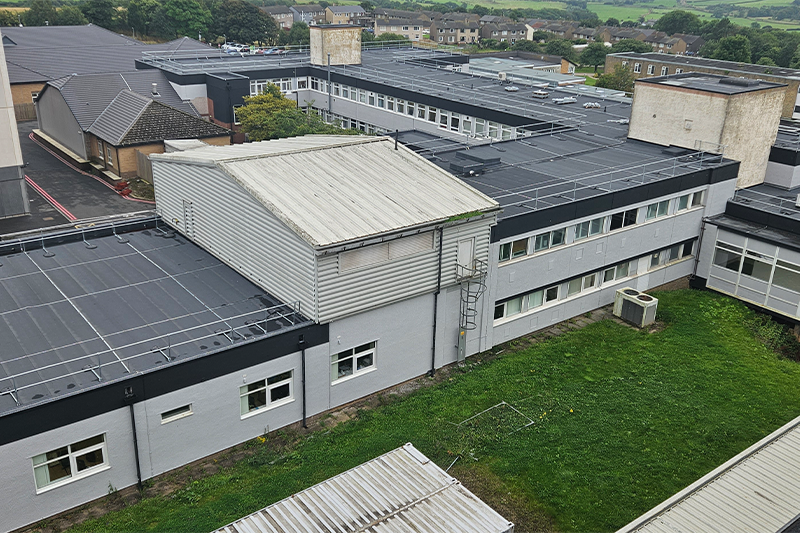
Across all parts of the NHS, roofs are quietly becoming one of the biggest maintenance challenges facing hospitals, healthcare facilities, community health centres and support buildings. While discussions around NHS infrastructure often focus on ageing hospitals, outdated facilities and major capital projects, the reality is that many of the problems affecting healthcare estates begin much higher up, writes Justin Pitman, sales director at Proteus Waterproofing.
The latest NHS Estates Returns Information Collection (ERIC) data shows that the maintenance backlog across the NHS estate has reached £13.8 billion, with more recent provisional figures suggesting the figure has now increased to almost £16 billion. This backlog represents work that should already have been undertaken to maintain buildings and infrastructure to acceptable standards.
Behind these headline figures lies a growing challenge for estates teams across the country. Many NHS buildings are ageing and many roofs are approaching or have exceeded their intended design life, having been subjected to years of patch repairs, budget constraints and reactive maintenance programmes. The result is an increasing risk of water ingress, structural deterioration, service disruption and escalating repair costs.
The cost of doing nothing
Roofing failures rarely occur overnight. In most cases, a leak is simply the visible sign of a much larger problem that has been developing quietly over a number of years. Minor defects that could have been addressed quickly and cost-effectively are often left unchecked, allowing blocked outlets to create standing water, waterproofing membranes to deteriorate, moisture to penetrate the building fabric and insulation to become saturated.
Over time, these issues can compromise the performance of the roof and contribute to the deterioration of structural elements beneath. What may have started as a relatively straightforward maintenance issue can ultimately develop into a complex and costly refurbishment project. This challenge is particularly significant within healthcare environments, where building performance is critical to maintaining safe, uninterrupted services for patients and staff.
Unlike many commercial buildings, NHS facilities operate around the clock. Clinical services cannot simply be relocated because a roof begins to fail. When water ingress affects wards, theatres, diagnostic equipment, electrical systems, or patient areas, the consequences extend far beyond the cost of repairing the roof itself.
Analysis of NHS estate data by The Guardian newspaper has shown that infrastructure failures have led to thousands of service interruptions and the loss of significant amounts of clinical time across the health service. Reports have identified incidents involving leaks, flooding, roof failures, electrical faults and other building-related issues that directly impact patient care.
In other words, roofing failures are not simply a maintenance issue - they can become an operational issue.
A growing estates challenge
The NHS estate is vast and complex, comprising hundreds of hospitals and thousands of healthcare buildings of varying ages and construction types. Many facilities were built during periods of rapid expansion and now require increasing levels of investment simply to maintain existing performance standards.
According to NHS England data, the cost of addressing backlog maintenance has more than tripled over the last decade, rising from around £4.5 billion in 2012/13 to £13.8 billion in 2023/24, before increasing further in provisional 2024/25 figures.
A significant proportion of this backlog relates to issues classified as posing either significant or high risks to service delivery, patients and staff. NHS data shows billions of pounds worth of maintenance works are now categorised within these higher risk categories.
While roofing is only one element of a wider estates challenge, it is often one of the most exposed and vulnerable parts of any building. Unlike many internal systems, roofs are continuously subjected to rain, wind, UV exposure, temperature fluctuations and general weathering. Without proper inspection and maintenance, deterioration is inevitable.
Why surveys matter
One of the most common issues encountered across ageing estates is that building owners often do not fully understand the condition of their roofs until a problem occurs. By that stage, repair options can be limited and costs significantly higher.
That is why a professionally undertaken roof survey is essential to provide clarity. It allows estates teams to understand:
- The current condition of the roof system
- Areas of deterioration or damage
- Potential water ingress risks
- Drainage performance
- Remaining service life
- Recommended maintenance priorities
- Future budget requirements
Perhaps most importantly, surveys allow building owners to move from reactive maintenance to planned maintenance, a change that can have a significant impact on both cost and operational resilience.
At Proteus Waterproofing, we understand the challenges facing estates managers across healthcare facilities. Our technical team works with building owners, consultants, contractors and facilities managers to assess the condition of existing roofing systems and identify practical solutions that support long-term asset management.
To support NHS estates teams, Proteus offers a free roof survey designed to provide an independent assessment of existing roof condition. The survey can help identify:
- Visible defects
- Potential causes of water ingress
- Areas requiring immediate attention
- Opportunities for refurbishment rather than replacement
- Long-term maintenance considerations
The objective is simple - to provide the information needed to make informed decisions before minor defects develop into major problems.
Prevention rather than reaction
The reality is that the NHS faces enormous pressure when it comes to maintaining and upgrading its estate. Budgets remain stretched and competing priorities are inevitable. However, the growing maintenance backlog demonstrates the cost of postponing essential works.
Every year that maintenance is deferred, the risk of failure increases. Every year that defects remain unidentified, repair costs can escalate. Every year that water ingress is allowed to continue, the impact on the wider building becomes greater.
All this means that the most cost-effective roof repair is often the one undertaken before a leak occurs. As NHS estates teams continue to address the challenge of maintaining ageing facilities, proactive roof inspections and planned maintenance programmes can play an important role in protecting buildings, safeguarding services and supporting long-term value for money.
Because when it comes to roofing, prevention will almost always be cheaper than emergency repairs.


