

Overview
The NHS has set out a bold direction for the next decade: shift care closer to communities, digitise the service, and pivot toward prevention. Those ambitions are right—and urgent. But the estate strategy that underpins them must also change, so frontline teams can deliver now while building the foundations for future care. This article proposes a Third Way for the estate: permanent-grade facilities delivered at pace that combine flexibility with clinical standards, complementing the New Hospital Programme and accelerating elective recovery.
The context: immediate pressure, long-term ambition
The NHS’s 10 Year Health Plan frames three “big shifts” to transform care: hospital to community, analogue to digital, sickness to prevention. It sits alongside operational guidance that asks systems to deliver productivity improvements while continuing elective recovery and service reform. Together, these set a clear strategic direction—but they also expose the tension between today’s constraints and tomorrow’s model.
Elective pathways and theatre capacity remain tight. The 2025 UK Surgical Workforce Census highlights that 53% of surgical consultants cite theatre access as a major challenge—driven by limited theatre space (73%), staffing (59%) and bed availability (47%). That is a system issue, not just a workforce one: without fit-for-purpose space, productivity gains stall.
Recovery is advancing, but slowly. Reports from late 2025 show ~7.4 million pathways and 62% of patients waiting less than 18 weeks, with surgical hubs and community diagnostic centres expanding—yet many schemes are still completing in 2026. This underscores the need to add capacity quickly while long-term programmes land.
Meanwhile, the New Hospital Programme has been reset with a more credible timeline and funding. That is welcome and necessary—but it does not negate the need for near-term capacity and adaptable environments to meet demand now and flex as the plan’s shifts unfold.
Why the estate must become an active enabler of reform
The 10-year plan puts digital, choice and prevention at the centre. Realising those aims requires environments that:
- enable straight-to-test pathways, same-day diagnostics and high-throughput elective centres;
- support team-based models in neighbourhood settings;
- embed digital workflows that improve staff experience and reduce friction;
- deliver clinically robust, safe spaces that feel indistinguishable from traditional builds.
NHS England’s 2025/26 guidance also asks systems to deliver 4% productivity improvements, enabled by technology, new capacity and operational reform. Estate solutions that can be stood up quickly—without compromising quality—become pivotal levers for activity and flow.
At the same time, modern methods of construction (MMC) are now business-case requirements for many NHS schemes (e.g., 70% MMC thresholds for new build), reflecting a policy shift to programme-based delivery and repeatable archetypes across diagnostics and elective care.
The “Third Way”: permanent-grade, delivered at pace
For decades, estate decisions have been framed as a binary: temporary facilities that deliver speed at the expense of experience and longevity, or traditional hospital builds that provide permanence but move slowly. The Third Way combines both: permanent-grade facilities at speed, designed to NHS clinical standards, built via MMC, and deployed where demand is acute.
What “permanent-grade” means in practice
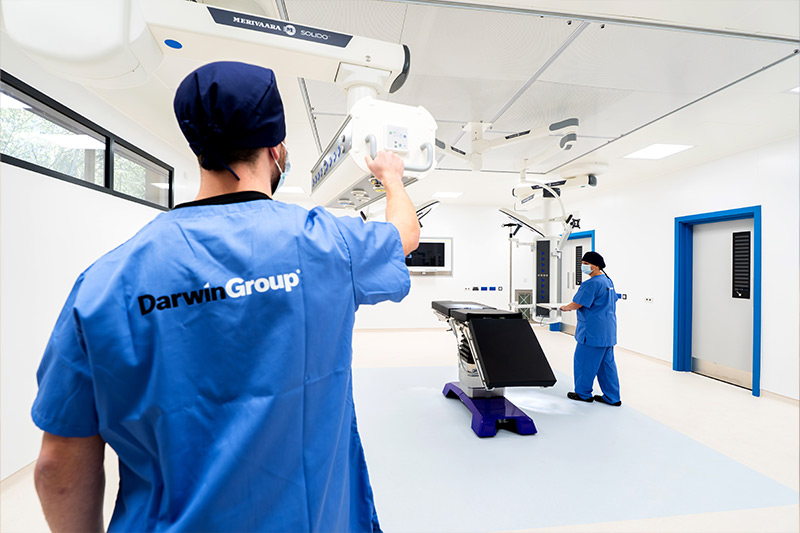
- Spaces that are indistinguishable in quality and experience from traditional buildings, with appropriate ventilation, infection control, adjacencies and clinical flows. A traditionally built operating theatre has a concrete floor, so a permanent-grade facility must have one too.
- Adaptable layouts and services (e.g., theatres, procedure rooms, recovery, diagnostics) that can be reconfigured as models of care evolve—consistent with the plan’s digitisation and prevention priorities. A building can be reconfigured on site, or removed and a new facility provided in its place.
- Programme-level delivery using repeatable, standardised designs coupled with off-site construction and fit-out to accelerate manufacturing and installation—reducing on-site disruption and moving activity earlier in the timeline.
Why this matters to elective recovery
- Immediate usable capacity for high-throughput surgical lists, ring-fenced elective beds and “straight-to-test” diagnostics—consistent with reform plans for surgical hubs and community diagnostic centres (CDCs).
- Protected training environments, helping address the census finding that theatre access and team consistency affect productivity, training and retention.
- Earlier operational payback: bringing capacity online sooner supports backlogs reduction and improves patient experience and choice.
A respectful challenge: blend agility with permanence
To deliver on the plan’s ambitions, the NHS will need more neighbourhood capacity and digitally enabled environments ahead of the full hospital pipeline. The challenge is not whether to build permanent hospitals (we must), but how to ensure the estate between now and then supports:
- Elective recovery targets and the constitutional standard pathway back to 92% by March 2029 (with interim thresholds),
- Workforce wellbeing, performance, and retention.
- Patient first-environments that enhance comfort, confidence, and outcomes---because patient experience is inseparable from clinical quality.
On-Demand® permanent-grade facilities—deployed where demand is highest—offer a credible way to de-risk delivery: they are built to last and designed to move or repurpose if priorities change. Likewise, they can be mobilised at pace to have an immediate impact while longer term solutions are still in planning. This adaptability aligns with the plan’s operating model and innovation agenda.
Complementing the New Hospital Programme, not competing with it
The reset of the New Hospital Programme and the Spending Review commitments are vital; large acute projects will anchor regional care for decades. The Third Way does not replace that work—it complements it by providing earlier capacity and standardised environments that support the plan’s big shifts, reduce pressure, and create space for reform. In effect, it is the connective tissue between recovery and reinvention.
Practical next steps for systems and trusts
- Map elective bottlenecks to estate constraints (theatre space, beds, diagnostics) and prioritise sites where permanent-grade rapid capacity will unlock activity fastest.
- Adopt programme-level delivery: bundle similar schemes (e.g., day-surgery theatres, endoscopy, “one-stop” CDC layouts) to gain speed and consistency across regions.
- Align digital and estates: ensure facilities are digitally enabled and future-proofed to remain always fit-for-purpose.
- Protect staff wellbeing: create standardised, familiar environments designed with clinicians in mind to support safety, wellbeing, productivity and patient care.
- Use business-case levers: reflect MMC thresholds and programme benefits to accelerate approval and funding confidence.
Conclusion
The NHS’s 10-year vision is compelling; the estate must make it real. By embracing a Third Way—On-Demand® permanent-grade facilities delivered at pace—systems can accelerate elective recovery, support workforce wellbeing, and lay the groundwork for the plan’s big shifts. It’s a respectful challenge to think differently about the estate: not as a static backdrop, but as a strategic asset that unlocks productivity and resilience—today and over the decade ahead.



