
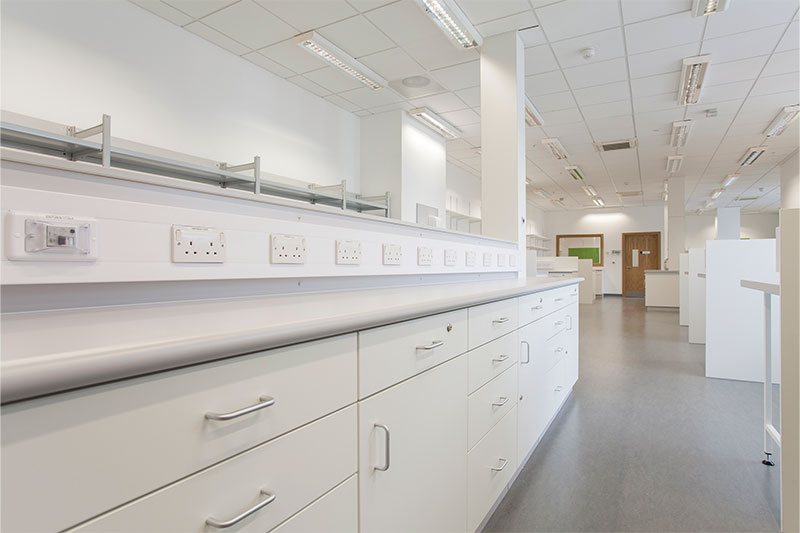
Within that pressure, fitted furniture can sometimes be viewed as a straightforward procurement line, a cost to be minimised rather than an asset to be evaluated strategically. However, in clinical environments, fitted furniture is not a short-term fixture. It is a heavily used, highly regulated component of the built environment that must perform reliably for years. When assessed over its full lifecycle, the cheapest upfront option can quickly become the most expensive decision, writes Katie Thompson, business development manager at David Bailey Furniture Systems.
Healthcare settings place extraordinary demands on furniture. Surfaces are subjected to frequent cleaning with strong chemicals. Edges encounter repeated impact from beds, trolleys and equipment. Storage units are opened and closed dozens of times each day.
In these conditions, material quality becomes critical. Lower-grade substrates can swell under moisture exposure. Inferior laminates may delaminate. Hinges and fixings not designed for intensive use can fail prematurely.
When components deteriorate, the consequences extend beyond aesthetics. Damaged surfaces can compromise infection control. Loose fittings create safety risks. What initially appeared to be a cost saving begins to generate reactive maintenance calls and operational disruption. Durability, therefore, is not about specification for its own sake. It is about ensuring that the environment remains safe, compliant and functional without continual intervention.
Maintenance cycles and hidden costs
Maintenance is often underestimated at the procurement stage. However, facilities teams understand that poorly performing furniture can generate a steady stream of minor repairs. Each call out carries a cost in terms of labour, replacement components and administrative time. In clinical areas, it may also require temporary decanting of rooms or restricted access, disrupting patient care.
By contrast, precision-manufactured fitted furniture designed specifically for healthcare environments can significantly extend maintenance intervals. Robust edging, moisture-resistant cores and reinforced fixings reduce the frequency of failure. The financial difference may not be immediately visible on a tender comparison sheet. Over five, ten or fifteen years, however, it becomes measurable - and material.
Replacement is rarely a simple swap. In operational healthcare buildings, removing and installing fitted furniture can have a cascade effect. Rooms may need to be taken out of service. Clinical schedules may require adjustment. Infection control protocols must be followed. In some cases, entire wards must be temporarily reorganised.
This disruption carries both direct and indirect costs. Lost bed days, altered patient pathways and additional coordination all affect operational efficiency. In high-demand facilities, even short interruptions have tangible consequences.
Specifying furniture with a longer service life reduces the likelihood of premature replacement. When upgrades are required, well-designed modular systems can enable targeted renewal rather than wholesale removal. Whole-life thinking therefore protects not only financial budgets, but also service continuity.
Compliance and risk
Healthcare environments also operate within stringent regulatory frameworks. Furniture contributes to compliance in areas such as fire performance, infection control and accessibility. Selecting lower-cost products without robust certification can introduce risk. If documentation is incomplete or materials fall short of required standards, remediation may be necessary - often at significant expense.
Moreover, reputational risk should not be underestimated. Facilities that visibly deteriorate undermine patient confidence. For healthcare providers, perception is inseparable from trust. Investing in fitted furniture designed specifically for regulated environments mitigates these risks. It ensures that technical performance aligns with legislative requirements and evolving best practice.
Whole-life value therefore, encompasses more than durability and maintenance. It includes adaptability, integration and long-term performance. Healthcare needs evolve. Clinical models change. Spaces are reconfigured. Furniture that has been designed with integration in mind, with aligned service panels, coordinated dimensions and consistent materials, can accommodate change more readily.
In contrast, fitted furniture procured purely on lowest price may lack the flexibility to adapt. Retrofitting becomes complex and costly. What initially seemed economical constrains future options. A whole-life approach evaluates how furniture supports the building over its intended lifespan. It considers replacement cycles, cleaning regimes, usage intensity and future reconfiguration. When these factors are quantified, the cost differential between “cheap” and “considered” often narrows significantly and frequently reverses.
Lifecycle thinking also intersects with sustainability. Replacing fitted furniture prematurely generates material waste and embodied carbon. Durable, repairable solutions reduce environmental impact over time and because healthcare providers are increasingly accountable for sustainability targets, fitted furniture selection plays a key role. In this context, the cheapest product may therefore, carry the highest hidden environmental price.
All this means that accurate lifecycle assessment requires collaboration. Engaging specialist manufacturers early in the design process allows performance criteria, usage patterns and maintenance considerations to be discussed openly.
At David Bailey Furniture, projects often involve detailed conversations about expected traffic levels, cleaning regimes and operational pressures. This insight informs material selection and detailing decisions. Such dialogue moves the conversation beyond unit cost. It reframes fitted furniture as infrastructure.
Rethinking “Value Engineering”
In many projects, value engineering exercises focus on reducing initial expenditure. While cost control is necessary, indiscriminate reduction can undermine long-term performance. True value engineering should protect lifecycle performance while identifying efficiencies in design and coordination. This may involve simplifying detailing, optimising layouts or rationalising material palettes, rather than substituting lower-grade components. When lifecycle cost is part of the discussion from the outset, decisions become more balanced and transparent.
Fitted healthcare furniture, however, is frequently perceived as background infrastructure. It does not carry the visibility of medical equipment or architectural features. Yet it is integral to daily operation. When specified with a lifecycle perspective, it becomes a strategic asset - one that supports compliance, reduces maintenance burden and protects service continuity. Conversely, when treated as a commodity, it can introduce ongoing costs that far exceed initial savings.
The challenge for healthcare estates teams, designers and procurement professionals is to broaden the evaluation framework. Upfront cost will always matter. But it should be considered alongside durability, maintenance cycles, disruption risk and adaptability. In environments where safety, reliability and trust are paramount, whole-life value is not an abstract financial concept. It is a practical necessity. Cheap is rarely neutral. Over time, it is often expensive.
For further information visit: www.davidbaileyfurniture.co.uk


