
Walk into most ICUs and you will see technically compliant environments where clinical teams deliver excellent care. Every standard met, every specification ticked off; yet opportunities remain to better support the staff who work 12-hour shifts under relentless pressure. Every estates professional recognises this tension.
Between 2012 and 2021, England added 368 critical care beds – a 9.9 per cent increase that brought the total to 4,095. On paper, this appears to be a success. However, the number of beds rose while the population grew exponentially faster. Once adjusted for population growth, the effective capacity gain reached just 2.2 per cent per 100,000.
As a nation, we built to comply. We delivered capacity. What we did not consistently deliver was environments optimised for patient recovery and staff wellbeing.
For estates and engineering leaders managing ICU projects today, this distinction matters more than ever. Compliance creates functional ICUs. Outcome-led design creates ICUs that protect patients, support exhausted staff, and safeguard the careers of those accountable for their performance.
The compliance foundation
No one dismisses the importance of regulatory baselines. HBN 04-02 establishes the fundamentals. HTM 06-01 mandates a 60-minute UPS backup for critical care environments. BS EN ISO 7396 governs medical gas pipelines, while BS 7671 sets electrical installation standards.
These regulations exist for good reason. They ensure an ICU can function, that physical space exists for equipment, and that power does not fail when needed most. What they do not ensure is optimised patient recovery or adequate support for healthcare teams working under pressure.
Compliance provides the floor, not the ceiling. For estates professionals, this difference determines whether your ICU becomes an operational asset or a source of ongoing concern.
The compliance trap
Compliance-driven ICUs meet every regulatory requirement, but often miss opportunities to enhance clinical effectiveness. Cable management systems pass inspections yet create cleaning challenges that infection control teams must work around. Equipment layouts satisfy spatial requirements while forcing awkward reaching and bending during patient care.
The Healthcare Safety Investigation
Branch has documented the links between poor ergonomics and patient safety. Fatigue and poor design are associated with increased risk of medication errors and never events. When a nurse on their tenth shift hour cannot reposition equipment smoothly, or when reaching for supplies means contorting around poorly placed infrastructure, patient safety suffers.
Your KPIs measure uptime and compliance, but your reputation rests on what happens when things go wrong. Poorly designed environments lead to more frequent errors.
Redefining ICU intelligence
The evidence for environment-led interventions in critical care has moved beyond emerging to established. Recent research demonstrates measurable clinical impact:
- A 2023 trial showed targeted environmental modifications reduced delirium rates from 86.7 per cent to 26.7 per cent.
- Adjustable LED lighting systems are associated with reductions in post-traumatic stress symptoms among ICU survivors.
- Window access and natural light lower the incidence of delirium.
- Uncontrolled artificial lighting disrupts
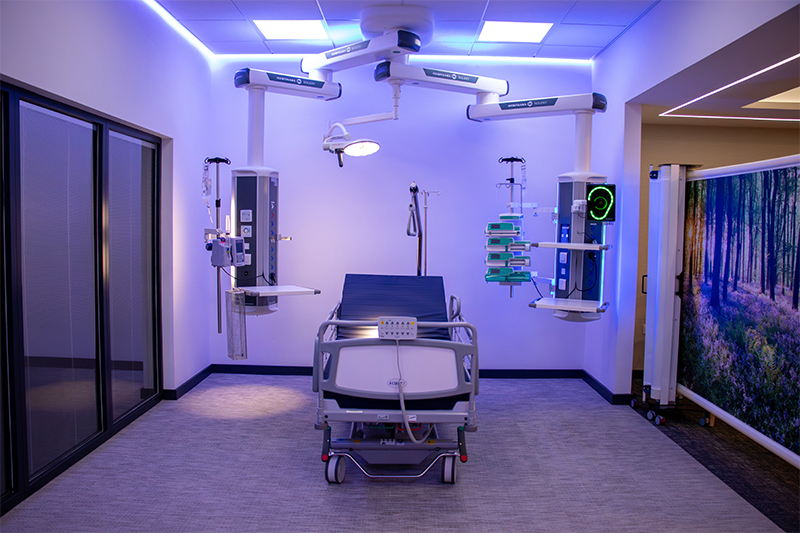
These represent measurable interventions with documented clinical impact, increasingly within reach of standard ICU projects. Colour-coded visual cues help staff map out pod layouts during emergencies.
Pendant-integrated alarm systems shave critical seconds off response times. Music and audiovisual integration allow sedated patients to maintain a connection with family voices, supporting psychological recovery alongside physiological treatment.
The goal is not to transform ICUs into hotel rooms, but to recognise that design choices previously considered aesthetic influence outcomes and that estates professionals can commission spaces that work with clinical teams rather than against them.
When you frame these interventions against the cost of extended stays, increased staffing burden, and reputational damage from poor patient experience, the business case becomes clear. Outcome-led design costs no more – it simply invests with purpose.
The case for ergonomics
NHS Human Factors guidance states explicitly that poor ergonomics combined with fatigue creates safety risks. However, ICUs continue to be specified with equipment that meets dimensional requirements while imposing unnecessary physical strain on staff. Pneumatic pendants remain compliant, durable, and ubiquitous. They also remain heavy, resistant to repositioning, and exhausting to use repeatedly across a shift.
Electromagnetic pendants eliminate this friction completely. Effortless repositioning allows staff to adapt the workspace to each patient’s needs without physical strain or workflow interruption. Better cable management reduces infection control risks and removes trip hazards. These changes reduce injury rates, support retention in a workforce already stretched to breaking point, and help maintain the 1:1 nurse-to-patient ratios that evidence links directly to better patient outcomes.
The Faculty of Intensive Care Medicine has clarified workforce optimisation requirements. The Royal College of Nursing has documented that each day of nurse shortage increases mortality risk by three per cent. During the pandemic, some units saw ratios diluted to 1:6 – a situation that no amount of compliance could make safe. When staffing becomes precarious, ergonomic design becomes a strategic necessity.
For estates leaders, this translates directly to SLA performance. Fewer staff injuries mean less sick leave. Better workflow efficiency means clinical teams can do more with constrained resources.
The predictive advantage
The most sophisticated ICUs anticipate problems. The NHS Plan for Digital Health and Social Care overtly highlights predictive monitoring and digital ICU infrastructure as priorities for modern healthcare. This represents operational pragmatism, not futurism.
Take into consideration electrical systems. Traditional approaches rely on reactive maintenance. Equipment fails, alarms sound, emergency repairs begin – and then KPIs feel the brunt. Predictive electrical monitoring completely inverts this model. By continuously analysing system integrity, our approach prewarns insulation degradation before failure occurs. This enables planned maintenance during scheduled downtime rather than emergency intervention during clinical operations.
For estates professionals, this is professional insurance. Preventive systems allow you to demonstrate proactive stewardship. When auditors or trust boards review performance, the difference between detecting and resolving a developing issue versus experiencing an emergency failure separates accountability from competence.
Emergency electrical work in an operational ICU costs exponentially more than planned intervention. The reputational protection alone justifies the technology, but the operational benefits
make it a strategic priority for any forward-looking estates programme.
Modular construction realities
Modular construction has entered the ICU conversation with considerable momentum. Airedale NHS Foundation Trust’s £15 million modular ICU project demonstrated that off-site construction can deliver improved infection control, enhanced sustainability and faster commissioning. The advantage proves genuine. Modular construction accelerates delivery while maintaining quality standards.
But it does not provide a shortcut around thoughtful design. It amplifies whatever approach you take. Build a compliance-driven ICU using modular methods, and you achieve compliance faster. Build an outcome-led ICU using modular methods, and you get a better ICU faster.
The critical variable remains the timing of clinical engagement. When estates teams involve intensive care clinicians, infection control specialists and human factors experts during the design phase, modular construction becomes a powerful accelerator of best practice. When those conversations happen after modules are specified, you risk standardising limitations as efficiently as you standardise strengths.
For estates leaders, early clinical engagement determines whether modular construction accelerates excellence or locks in mediocrity.
The strategic choice
Every estates professional managing ICU projects faces an important decision. You can deliver compliance-driven adequacy, or you can provide outcome-led excellence. The first path proves defensible. The second path proves strategic.
Compliance-driven ICUs create ongoing reputational exposure. When clinical outcomes suffer, staff retention falters or patient experience scores decline. The question inevitably becomes whether the environment could have been better. With outcome-led design, the answer is clear.
The encouraging reality is that the right approach does not demand unlimited budgets or revolutionary technology. It requires early engagement with clinical teams, evidence-based specification, and a willingness to prioritise interventions with documented impact. Adjustable lighting, ergonomic equipment, intelligent cable management, and predictive monitoring are proven and increasingly accessible.
The ICUs being commissioned today will still protect patients for decades to come. In ten years, the measure of success will be whether you commissioned an environment that
supported patients and staff, not just one that met the minimum standard required by law.