
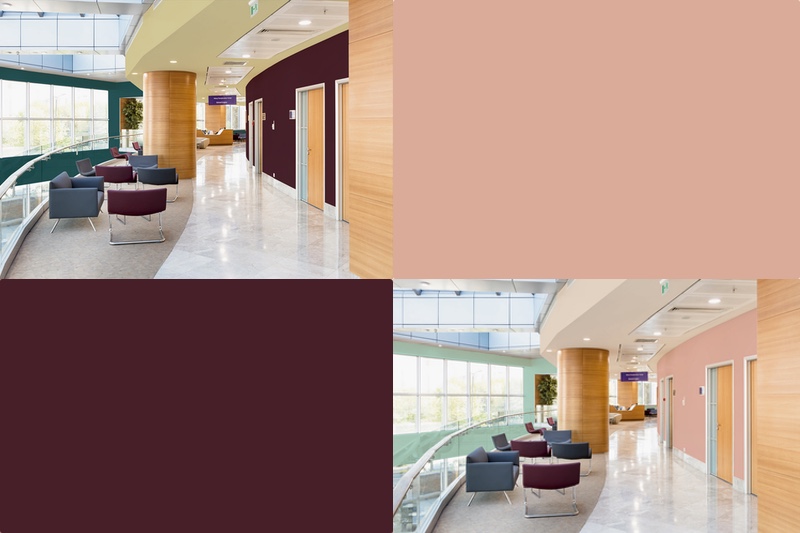
Designing for healthcare is a tough balancing act. Spaces need to be easy to navigate while supporting the wellbeing of both staff and patients. Walls must also be easy to clean, antibacterial and create a welcoming and reassuring environment.
Creating a home from home for those within a care setting
Care homes have to cater to a wide range of needs, from people living with dementia to those with complex physical conditions, and at the same time, it’s important to make sure residents feel at home.
When designing care spaces for elderly patients, it’s important to consider their eye health.
Colour vision starts to decline in the ageing eye, so areas where we want colour to capture the user’s attention should be vibrant, with soft pastels and grey tones avoided as they can become lost.
And we know that as well as helping to create warm, homely, more welcoming spaces, warmer tones such as reds and oranges will be more prominent to ageing eyes than blues and greens.
Contrast can also be less noticeable as vision decreases. Designers need to carefully consider their colour schemes and how those using the space will see them.
When used correctly, colour can be a wonderful tool for reducing the risk of bumps and falls, as well as making it easier for those struggling with memory loss or sensory impairment to navigate the building.
Doors that are off limits to residents can be camouflaged by painting them in the same tone as the walls surrounding them. This makes them much less visible and the desire to enter those spaces is significantly reduced.
A safe, reassuring hospital environment
For many, hospitals are an emotional and uncertain space. Visitors and patients both need to feel reassured and welcomed into a hospital environment.
We recommend taking a more


