
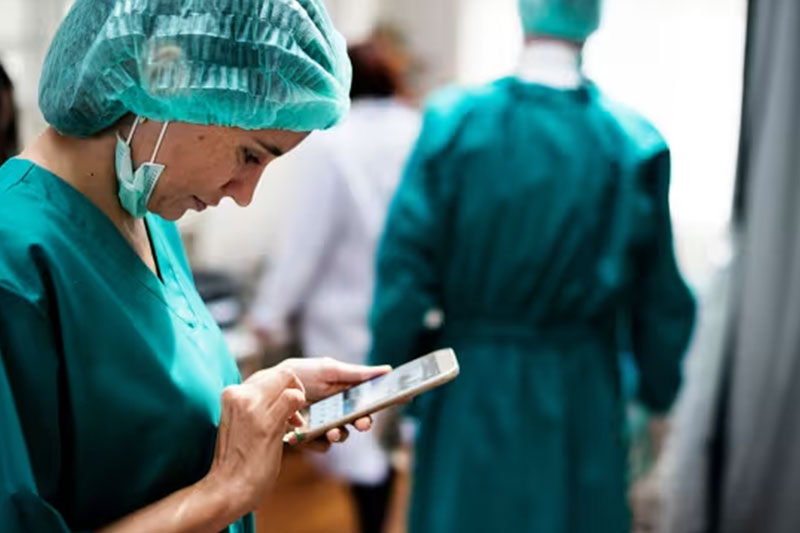
Mobile devices have become an important part of modern clinical care, giving clinicians greater flexibility to work at the point of care. But as their use expands, healthcare organisations also need to ensure these devices are secure, available and easy for clinicians to access without adding friction to already demanding workflows.
Making a difference in healthcare
The portability and ease of use of mobile devices have already brought many benefits to healthcare delivery. Their portability and convenience can support more efficient care, making them highly valued by clinicians. However, they also pose challenges, both in terms of security and the practical issues around managing battery life.
They can enable a clinician to attend to a patient at the point of care in a busy Emergency Department, whether to provide a patient with quick pain relief medication, completed via a closed-loop medication administration process, or enter vital signs for patients as part of hourly checks and rounds, or complete fluid balance charts. These are all routine tasks that are part of everyday nursing care that may ordinarily require trolleys, workstations on wheels or even pen and paper, in an environment that is all too often difficult to access and manoeuvre across a crowded area.
However, mobile devices also introduce security challenges because they change hands frequently and, in some organisations, multiple users may share a generic device PIN or application account. Smaller than traditional PCs and laptops, using long passwords can be fiddly to key in, which can also result in users adopting insecure workarounds for speed of access.
Managing devices ensures availability
It is essential that such mobile devices are secured to protect systems and applications from cyber threats, as well as tracking who is accessing the data within the clinical environment, both for information governance and patient safety.
Another challenge with mobile devices is managing battery life to ensure optimum use. We all know how frustrating it can be to pick up your own device at home, only to find that the battery has not been charged. In the same way, in the healthcare environment, there needs to be plenty of charging stations available, and the discipline and processes in place to ensure that the units are replaced after use. I am sure I am not alone in finding a device when on a shift and skipping down the corridor in glee with it in my back pocket, only to find that the battery is down to 10%. Do I hang on to it and use it while it lasts, or place it back on the charging station only for someone else to grab it?
There are some healthcare organisations that have already solved this issue, where mobile devices are successfully managed and used. Clinicians need simply to ‘tap and go’ to log in before their shift. Built-in timeouts ensure that sessions are logged out and that devices are digitally sanitised. In addition, charging stations are available to ensure continuous use, with batteries available to support ‘hot swaps’, maintaining the user’s session data without having to log in again.
Secure workflows improve efficiency
One of the most important things about security is that it should protect users and systems without creating unnecessary barriers to work. This is particularly critical in a healthcare environment where clinicians are often working under pressure in busy departments. Having to remember logins and secure passwords puts additional pressure on care delivery.
For this reason, secure workflows using mobile devices need to be designed with the user in mind. In fact, guidance from the National Cyber Security Centre (NCSC), Secure by Design Principles, states that regular research and findings need to be carried out for design, to ensure that devices are easy to use and understand.
Principle 4 states that the outcomes should be: “A secure service with security controls that minimise friction for users” and, additionally, “Insecure practices are avoided by removing incentives for users to find workarounds”.
Identity is central to security
Security is a multi-layered strategy of defences and mitigations, of which identity is a crucial and critical part. In the healthcare environment, the identity of a user has real clinical value in three different areas: cybersecurity and efficiency, access and capability, and clinical governance and accountability.
Strong user identities are an effective way of protecting applications from the risks of cyber threats. In addition, providing an easy, fast way for a clinician to prove identity and access healthcare applications helps to improve efficiencies.
The workflow is essential to this. Key questions to think about during the design phase are:
-
What is the user trying to accomplish when interacting with the device, and what needs to be protected at that point in the workflow?
-
What level and type of security is appropriate for that activity, and how can it protect access without creating unnecessary friction or disrupting care?
Identity supports access and inclusion
IT departments can work with clinicians initially to identify which applications they are most likely to access. They can configure identity and access around a user’s role and department, helping clinicians move efficiently between the applications they need. This also meets the requirements of clinical governance. The logins and timings can be recorded for audit purposes, helping to ensure that the right people have access to the right levels of authority.
Another advantage of providing easy, fast, secure identity logins is that it increases digital inclusion. As healthcare organisations undertake their digital transformations, it is important that all users, whether clinicians or administrators, can access the systems that they need to carry out their jobs without the technology becoming a barrier.
Future developments benefit patients
Investment in mobile devices over recent years has been huge, overtaking that for PCs and laptops, whether for personal use or in the workplace. Mobile applications are also being used to support more workflows across sectors, including healthcare.
When security and accessibility come together, mobile devices can support a variety of innovative use cases that improve the experience of patients and staff at the point of care. One particular example that I’ve seen repeated around the globe, in the UK, Norway and Australia, is the concept of the ‘silent hospital’.
The idea is that silent wards aim to reduce unnecessary noise while maintaining patient safety. They use technology to replace non-essential audible alarms and call bells with digital workflows that notify the right staff member directly.
Research has shown that in neonatal departments, for example, the number of healthcare devices used for monitoring, and the noise that they make, can increase patient stress and anxiety.
There is a range of technology that needs to knit together in achieving a quiet ward, including:
-
Mobile nurse call systems, where patient calls are routed to staff smartphones or mobile devices.
-
Clinical alarm management, where alerts from monitors, pumps and other devices are prioritised and sent to the relevant clinicians.
-
IoT noise monitoring, where sensors continuously measure noise levels to help identify problem areas.
-
Location services such as Bluetooth, Wi-Fi and RFID technologies that help to direct alerts to the nearest appropriate staff member.
-
Smart room controls, where occupancy sensors and automated lighting reduce disruption.
-
Integrated communications that combine messaging, task allocation and nurse call functions into a single digital workflow delivered to a user’s mobile device.
In this way, mobile workflows can help create quieter environments that benefit patients. But success depends upon robust identity, access and device management processes.
It’s truly exciting to see the level of innovation being driven by mobile devices across different countries and environments, to the benefit of both patients and staff. These examples also show that mobile device security and management are key to designing a successful digital transformation.
Daniel Johnston, MRes, RN, Director Clinical Operations International at Imprivata, is a practising nurse with over two decades of experience in the UK and US.


