

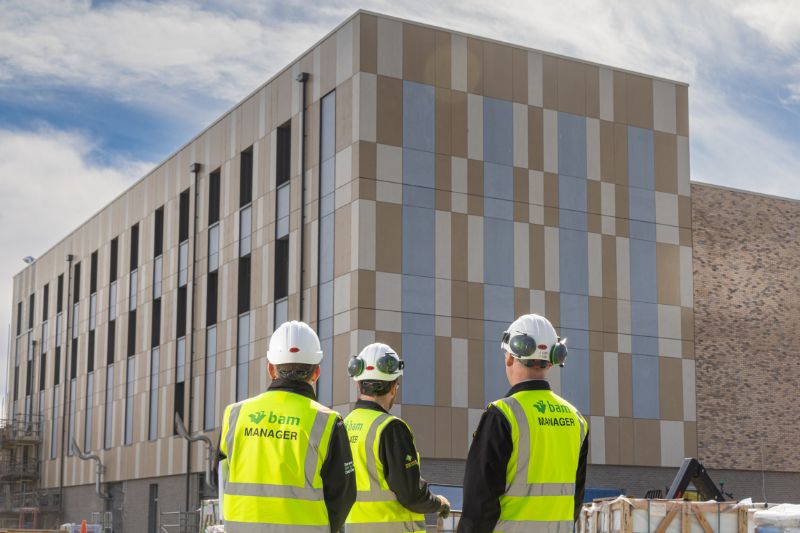
For more than 40 years, a prominent plot in Plymouth’s city centre stood largely unused, a gap in the urban fabric just minutes from the bustle of the city market.
Now, that same site is being redefined as a cornerstone of modern healthcare delivery.
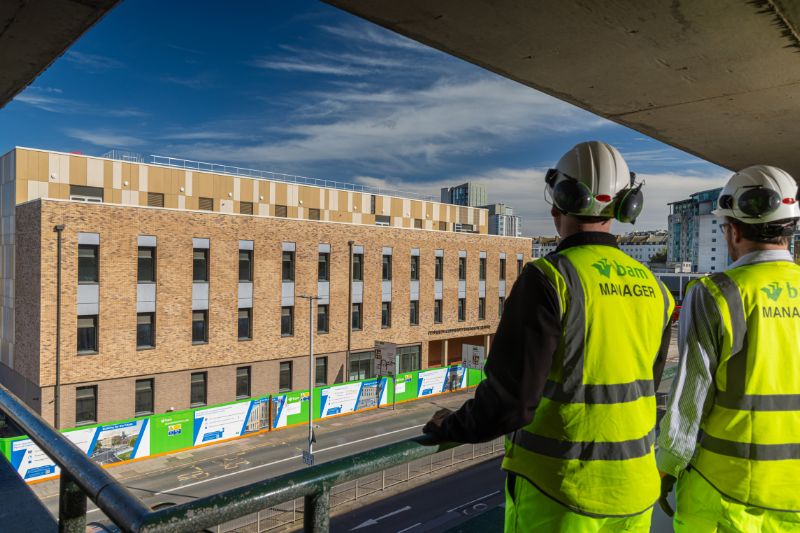
On a clear spring morning, I arrive at Plymouth city centre to see how the construction firm BAM UK and Ireland has turned that long-dormant space into a three-storey Community Diagnostic Centre (CDC) for University Hospitals Plymouth NHS Trust.
Expected to open in June, the £21.96m facility is in its final stretch, and already hinting at the operational intensity it will soon support.
A building shaped by diagnostics
“Everything here starts with the equipment,” explains Tim Chell, Health Sector Director at BAM UK and Ireland, as we begin the tour.
It’s not just a guiding principle, it’s literal.
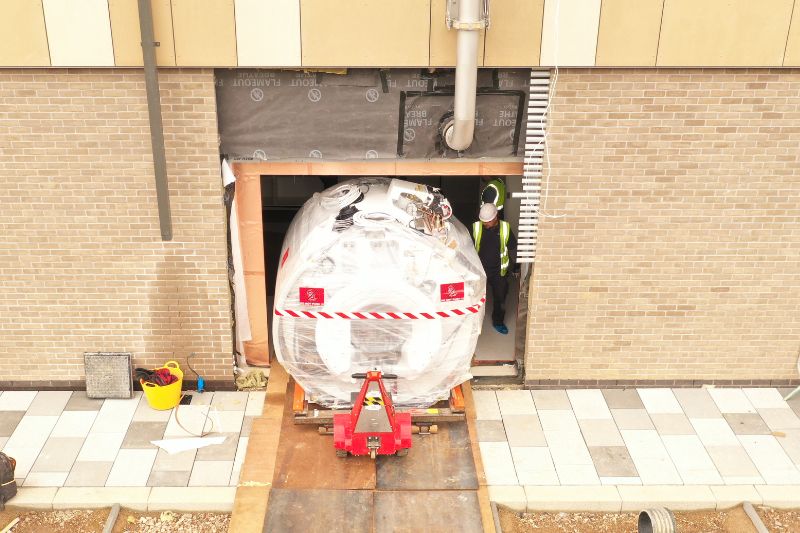
Two sections of the building had to be opened up during construction simply to allow MRI scanners inside.
The wall was built in such a way that it was easily removable, known as a “knock out panel”, and now that the machine is inside a permanent wall is being installed.
“You don’t design these buildings and then fit the kit in later,” said Chell. “You design around it from day one.”
That approach is immediately evident as we move through the building.
The three-storey layout is stacked with precision: two MRI suites on the ground floor, two CT scanners on the first floor, then two X-ray facilities on the third floor.
There are also four ultrasound rooms, a phlebotomy room, cleaning facilities and changing rooms on the ground floor.
The first floor has lung function suites and consultation rooms on the first floor, and staff rest rooms, audiology rooms and workshop spaces for fixing audiology equipment are on the second floor.
Each floor reflects a careful calibration of weight, shielding, vibration control, and patient flow.
Inside, patient experience has been carefully considered.
Acoustic treatments reduce noise and reverberation, particularly in audiology rooms, while interior finishes and colour schemes aim to create a calmer, more accessible environment.
At full capacity, the CDC is expected to deliver around 135,000 tests per year, roughly 330 to 340 appointments per day.
History of procurement
The Colin Campbell Court site, where the CDC now sits, was long earmarked by Plymouth City Council for regeneration.
The site stood for nearly 40 years as a fragmented mix of surface car parking and underused buildings near the city market.
BAM was appointed to the project in 2024 by the University Hospitals Plymouth NHS Trust through the Southern Construction Framework (SCF), a pre-approved public sector procurement route that runs competitive tenders among selected contractors.
“Many public sector organisations have had to come together to make this project a reality. We were approached by University Hospital Plymouth in late 2024 to talk about how we could help with this project,” Matthew Elliot, Senior Framework Manager at Southern Construction Framework told Building Better Healthcare.
Elliot said that the procurement process took about three months, from the first point of engaging contractors to the final point of BAM being selected as the preferred bidder.
“One of the benefits of using SCF is we maintain our support throughout the entire project life cycle: procurement, pre-construction and finally construction,” said Elliot.
The SCF works across most sub-sectors and operates primarily across London, South East and South West.
Over £10bn worth of construction projects have been delivered through the framework in the past two decades.
Putting care closer to Plymouth communities
The strategic intent behind the CDC project is clear.
Derriford Hospital, Plymouth’s main acute site, sits around 18 minutes away by car, longer in peak traffic.
By relocating high-volume diagnostic services into the city centre, the CDC is designed to “decompress” the acute estate.
“It’s about getting people seen faster and closer to home,” says Chell. “We know there’s a huge backlog in MRI and CT. Facilities like this are how you start to tackle that.”
Patients will access the centre via GP referral, with appointments spanning a wide range of modalities, including advanced cardiac CT scanning in a community setting.
The ambition is to create a “one-stop shop” for patients with multiple conditions, reducing the need for repeated hospital visits.
Flexibility built in
If there’s one theme repeated throughout the tour, it’s flexibility.
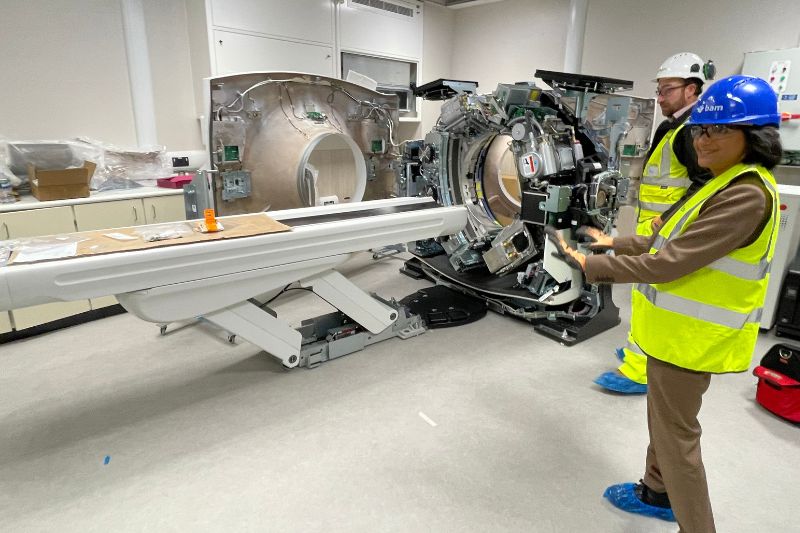
Several rooms have been deliberately left “non-specific”, designed to adapt as demand shifts between diagnostic types, and for future add-ons as diagnostic technology advances.
BAM said the chosen diagnostic tests depend on the different local needs, such as the need for DEXA scanners for bone fractures in areas with an older population.
Administrative and clinical teams will be able to book and reconfigure spaces as needed, a response to the evolving nature of healthcare demand and funding models.
“It’s getting that design that will fit into the space long term,” says Chell. “Demand will change, it always does. So you need buildings that can change with it.”
This flexibility extends to the technical infrastructure too.
Behind the scenes, systems are being rigorously tested: from air flow rates and temperature control to infection prevention measures, emergency lighting, and acoustic performance.
“Commissioning has to be spot on,” Chell adds. “You don’t want to be going back in later to fix issues in a live clinical environment.”
Engineering complexity on a compact site
With a gross internal floor area of 3,260 sqm, the building sits on a tight urban footprint, and at peak construction, up to 150 workers have been operating on site.
Greg Browne, Construction Manager at BAM, points to the logistical challenges this creates.
“You start with a plan, but things evolve, especially when additional equipment or funding comes in. Then the programme and design have to adapt with it.”
Digital tools have played a key role in managing that complexity.
Using platforms such as Holobuilder, the team has captured 360-degree imagery of every room twice a week, creating a detailed visual record of progress and enabling real-time coordination across trades.
“It gives us one source of truth,” Browne explains. “Everyone’s working from the same information.”
Sustainability and performance
Sustainability has also been embedded into the design.
The building incorporates air source heat pumps, rooftop photovoltaic panels, and energy-efficient systems designed to exceed Part L requirements.
Part L of the building regulations focuses on the conservation of fuel and power in new and existing buildings in England.
The regulation calls for a 31% reduction in carbon emissions for new and refurbished buildings.
Plymouth also has a local planning policy in place to ensure all major developments contribute to the 50% carbon reduction target by 2034.
Plant equipment fills much of the third floor roof space, reflecting the energy demands of a diagnostics-heavy facility, but also the effort to minimise long-term operational costs.
Social value and local impact
Beyond healthcare delivery, the CDC is positioned as a catalyst for wider regeneration in Plymouth’s west end.
BAM reports that around two-thirds of project spend has gone to local suppliers, exceeding initial targets.
Meanwhile social value initiatives have included apprenticeships, community engagement, and charitable contributions to local healthcare causes.
“Every healthcare job creates two or three more in the wider economy,” notes Browne. “Cleaning, catering, maintenance, it all adds up.”
With 120 full-time staff set to operate the centre, and neighbouring developments such as the repurposing of the city’s civic centre, the CDC forms part of a broader vision for a city-centre “health campus”.
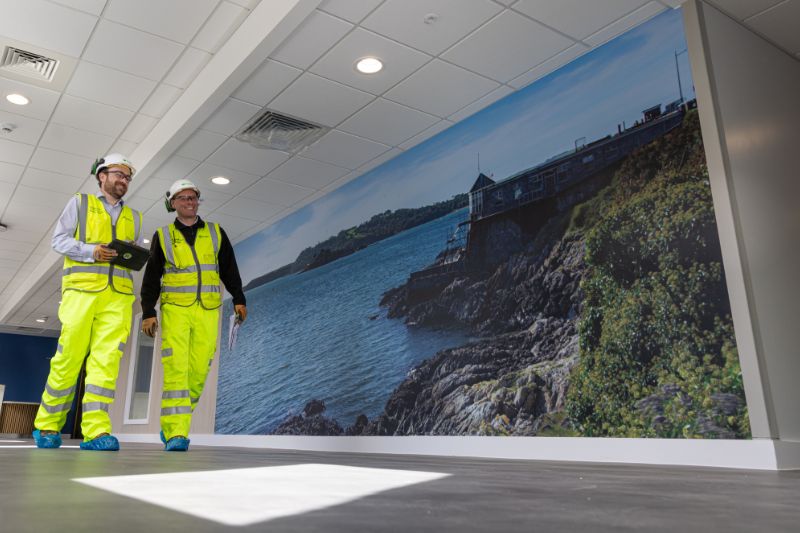
Artwork across the waiting rooms of the building has also been shaped through competitions with local artists, with each floor adopting a distinct theme for wayfinding: from sea-inspired scenes with flowing wave motifs, to vibrant cityscape illustrations, and expansive countryside views.
The wider national CDC model
Plymouth’s CDC is one of dozens planned across the UK as part of a wider push to expand community-based diagnostics, with 170 CDCs operational across the UK.
But while the model may be national, its delivery is distinctly local.
From early public consultation, including visualisations to engage residents, to ongoing clinician involvement through a 22-member steering group, the project has been shaped by those who will ultimately use it.
BAM is working with MEP provider GE Healthcare and MEP supply chain partner Totus Engineering, which was appointed by the Trust to supply and install the CT and MRI machines, and MIS Healthcare and Samsung for the X-ray machines.
The local architectural firm KTA worked on the overall design of the building with BAM.
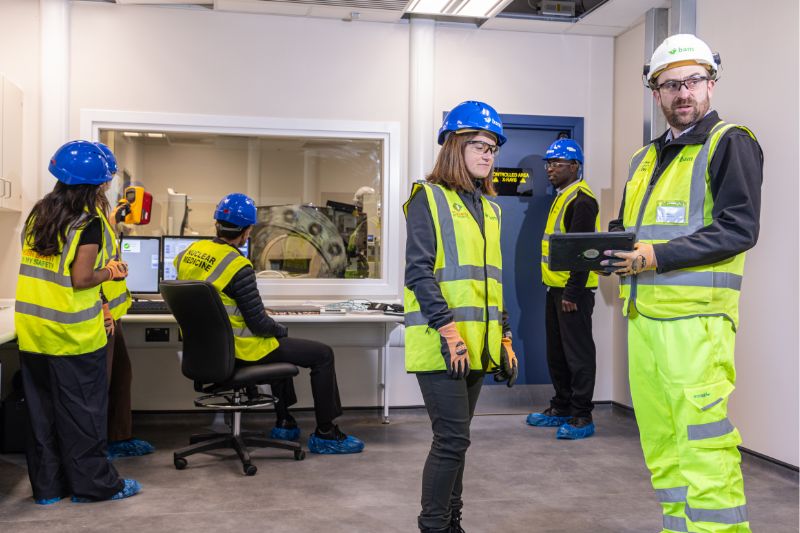
As we wrap up the tour, final commissioning works are underway: X-ray leakage testing, fire alarm validation, lift certification, and system integrations that will allow the first patients to be safely received.
It’s a meticulous process, and one that underscores the complexity behind what might, from the outside, look like a straightforward building.
But standing in a space that was, until recently, little more than an underused plot, the transformation is striking.
Soon, this will be a place where thousands of patients each year come for answers, faster, closer, and in a setting designed for the future of diagnostics.


