

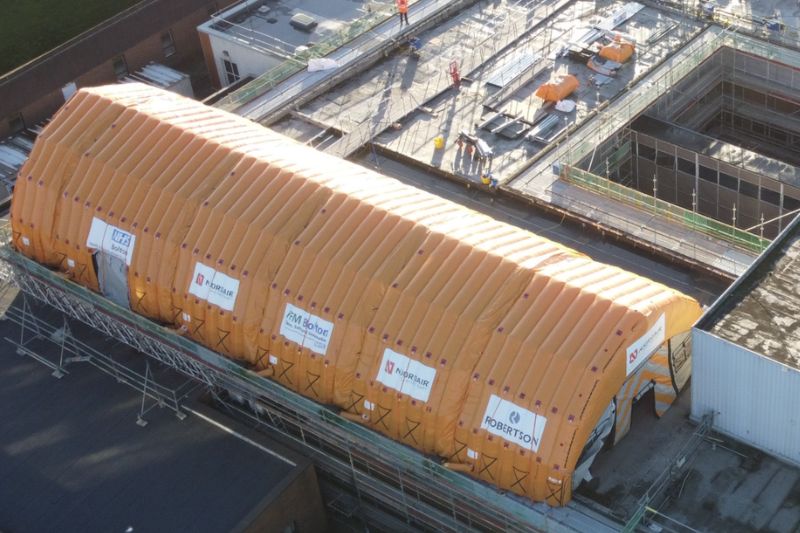
Robertson Construction North West has installed a first‑of‑its‑kind inflatable roofing solution on the £38m redevelopment of Royal Bolton Hospital, enabling comprehensive roof replacement while the maternity unit continues to operate.
“This initiative demonstrates what’s possible when our teams challenge convention, share expertise, and embrace innovation to deliver real value for our customers and the communities they serve,” said Elliot Robertson, CEO of Robertson Group.
The installation of the 35m-long air-filled tent to the roof is the first time that technology has been used for a roofing solution by a Tier 1 contractor.
The modular air‑filled structure provides a fully weatherproof working environment that can be rapidly deployed and reconfigured at height, allowing the critical roof renewal to take place without disrupting vital hospital services.
The tents, powered by the hospital’s mains electricity and capable of being inflated in minutes, replace traditional external sheeting and extensive scaffolding.
Traditional scaffolding could not be used as it posed significant challenges for the hospital because of the roof’s complex layout, with interconnected buildings and the need for 24-hour access to critical areas such as the hospital’s oxygen store.
The solution enhances safety, maintains uninterrupted access to clinical areas and minimises impact on patients, staff and ongoing operations.
As part of the roof renewal programme, 100% of the maternity unit’s RAAC roof will be replaced and upgraded with new mechanical and electrical systems, supported by 13 modular tent structures over the 40-week project.
The modular tents are being used to cover the entire roof replacement programme.
The nationwide effort to remove RAAC
RAAC, a lightweight concrete commonly used in hospitals built between the 1950s and 1980s, can fail suddenly as it ages, posing a critical safety risk.
The concrete has a porous structure that allows water to enter, which can cause its internal steel reinforcements to corrode and lead to cracking over time.
The NHS is taking steps to remove RAAC from seven hospitals in the New Hospital Programme.
The removal of RAAC was originally scheduled to be completed by 2030, but the programme is now behind schedule, with replacements not expected until 2032–33.


