
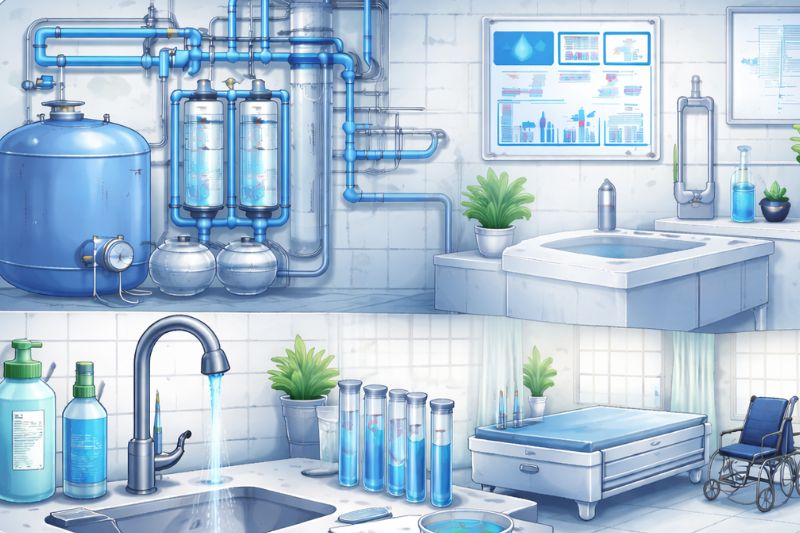
The landscape of water safety in healthcare is undergoing a period of transformation as the NHS looks to the future of its facilities and operations. The introduction of new design briefs and specifications for sanitaryware, fittings and water systems marks a major shift in how hospitals will manage and regulate water.
While the ambition of these briefs is clear: to improve patient safety, reduce lifecycle costs, and standardise procurement across NHS Trusts, the future of water safety in healthcare now depends on how effectively legislation, engineering and infection control can align to create environments that are not just compliant, but truly safe.
Regulation driving reform
The UK already operates within a rigorous framework of water safety standards. Regulations such as the Health and Social Care Act 2008 (Regulated Activities) Regulations 2014, HSG274 Part 2, and HTM 04-01 set out clear expectations for the management of water systems to control infection risks, including those posed by Legionella and Pseudomonas aeruginosa.
The latest phase of reform, including updates to Healthcare Building Notes (HBNs) and technical memoranda, aims to strengthen this framework further.
In principle, these standards are intended to deliver more efficient, sustainable and hygienic facilities. In practice, however, certain proposed requirements, such as fixed water temperatures, touchless sensor controls, greywater reuse and adjustable fixtures, risk introducing complexity and even new pathways for contamination.
Balancing innovation with infection control
Water is both a lifeline and a potential liability in healthcare settings. Poorly managed systems can provide ideal conditions for bacterial growth and biofilm formation, posing risks to patients who are already vulnerable to infection.
As part of the move towards smarter hospitals, the introduction of automation and digital monitoring promises to make water systems more intelligent, tracking flow rates, temperature and blockages in real time. Yet an over-reliance on automation could have negative impacts on the real-world realities of working in clinical environments.
Sensor-controlled taps and showers, for instance, may reduce touchpoints but can also harbour stagnant water chambers where pathogens thrive if not properly flushed or maintained. Meanwhile, proposed changes to water temperatures need to be carefully tested and peer-approved, with robust scientific evidence, before change is implemented.
True innovation in water safety must therefore strike a balance between technology, practicality and infection control. The key lies in simplicity, adaptability and ensuring every new specification is grounded in evidence and validated through real-world testing.
Designing for flexibility
Standardisation is central to the government’s hospital-building ambitions, intended to streamline supply chains and reduce costs. However, an overly rigid approach could undermine this goal.
Healthcare environments are inherently diverse, with different patient populations and clinical needs. A single design solution, whether for a hand wash station or a shower system, is unlikely to suit every ward, unit or patient group. Instead, there is scope for a modular approach that puts flexibility at the heart of future hospital design and the evolving needs of each space, making it easier to adapt to different clinical settings.
This philosophy reflects the broader shift in modern hospital design towards modular construction and plug-and-play systems. However, any modularity must be implemented carefully. Retrofitting, for example, can increase the risk of contamination if pipework is disturbed. Meanwhile, adjustable fixtures and complex interlocks can raise maintenance demands, an acute challenge in a sector already facing labour shortages.
Evidence before implementation
For healthcare water safety to advance, policy must evolve in step with engineering insight, infection control expertise and patient experience. New legislation should be informed by real data, including how design changes affect hygiene compliance, maintenance regimes and overall patient safety.
Interdisciplinary collaboration is key. Engineers, clinicians, infection control professionals, manufacturers and patients must all have a voice in shaping the future of hospital water systems. Without it, even well-intentioned guidance may fall short of delivering genuine safety improvements.
Towards a safer, smarter water future
As UK healthcare facilities face growing operational and environmental pressures, the importance of safe, efficient and sustainable water management has never been greater.
Legislation can, and should, serve as a catalyst for improvement. But achieving safer water in healthcare environments will depend on clear communication, sound science and practical implementation.
Emerging standards and technologies must work hand in hand with the core principles of risk assessment, maintenance and hygiene. That means prioritising function over form, collaboration over prescription, and evidence over assumption.
The future of water safety in UK healthcare will be defined not just by new laws, but by how effectively we learn from the past, designing systems that protect patients today while adapting to the challenges of tomorrow.


