
Interventional radiology (IR) plays an increasingly important role in modern healthcare. From vascular interventions and oncology procedures to emergency embolisation and stroke treatment, these techniques are transforming patient pathways and improving recovery times.
As demand for minimally invasive procedures continues to grow, pressure is also increasing on the environments in which they are performed.
This raises an important question: are interventional spaces adapting sufficiently to the needs of clinical teams to reduce patient risk, or are they still too often being asked to adapt to the limitations of the environment?
In practice, many interventional workflows still rely on moving the patient to obtain the imaging required, introducing additional variables into procedures that depend on precision.
In modern IR practice, maintaining a stable patient position is not simply a matter of comfort. It plays an important role in supporting procedural precision, patient safety, and workflow control.
For this reason, patient stability should be considered an essential part of the clinical workflow, particularly in environments where repositioning may still be needed to accommodate procedural or system-related constraints.
Why patient movement can increase risk
Interventional radiology relies on precise, image-guided navigation to reach a defined target within the body. Even small shifts in patient position can alter the relationship between the imaging and the anatomy, potentially affecting accuracy and increasing the risk of patient safety at critical moments.
For example, during vascular procedures, clinicians often rely on digital “roadmaps” of the patient’s blood vessels. If the patient is repositioned, this alignment can be lost, increasing the risk of navigational error and requiring additional imaging to regain orientation. This not only prolongs the procedure but may increase radiation exposure and procedural complexity.
Reducing the need for repeat imaging is more than a matter of efficiency. Clinical guidance across interventional and radiological practice consistently emphasises minimising radiation exposure wherever possible, particularly in procedures where cumulative dose can become significant.
Patient movement can also compromise the placement of devices such as guidewires, catheters, and stents. These instruments are often positioned with a high degree of precision. Repositioning the patient introduces the risk of displacement, which may require correction and increase the likelihood of complications.
Reducing the need for repeat imaging is more than a matter of efficiency
There are also direct safety considerations. Moving a patient with fragile anatomy or active internal bleeding can increase the risk of trauma. In sedated patients, repositioning can introduce additional risks such as skin shear or nerve compression, particularly during longer procedures.
Infection control is another critical factor. Interventional procedures are carried out within carefully controlled environments, and repositioning the patient can disrupt this control, increasing the risk of contamination or exposure.
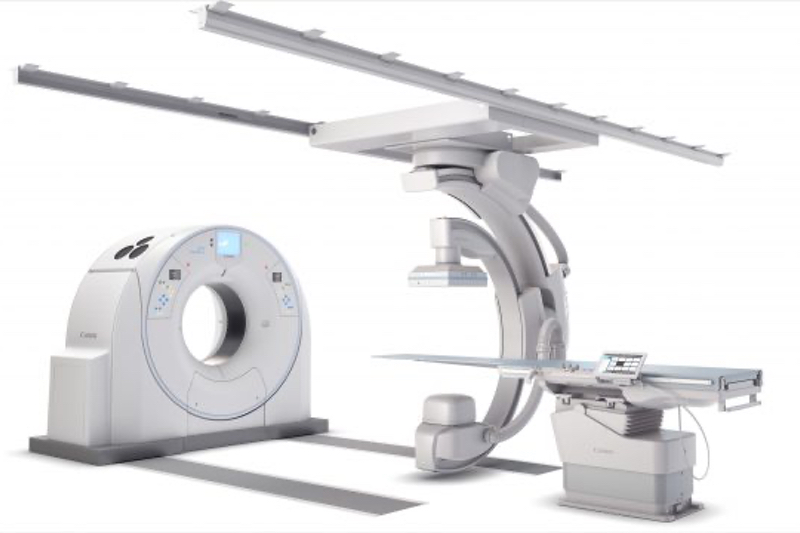
Taken together, these factors reinforce a clear principle: maintaining patient stability is essential for safe and effective interventional radiology. For this reason, moving the imaging system rather than the patient is increasingly recognised as the gold standard in modern IR practice.
This reflects a broader shift in interventional system design towards enabling full anatomical coverage and positioning flexibility without requiring patient repositioning.
Precision, safety and efficiency in practice
Designing procedures around a stable patient position allows clinicians to work with greater control and confidence.
Advances in interventional imaging are making this increasingly achievable. Modern systems are increasingly designed to adapt to the clinical need, enabling full anatomical coverage without requiring patient repositioning.
Modern fit-outs with C-arm systems can


