

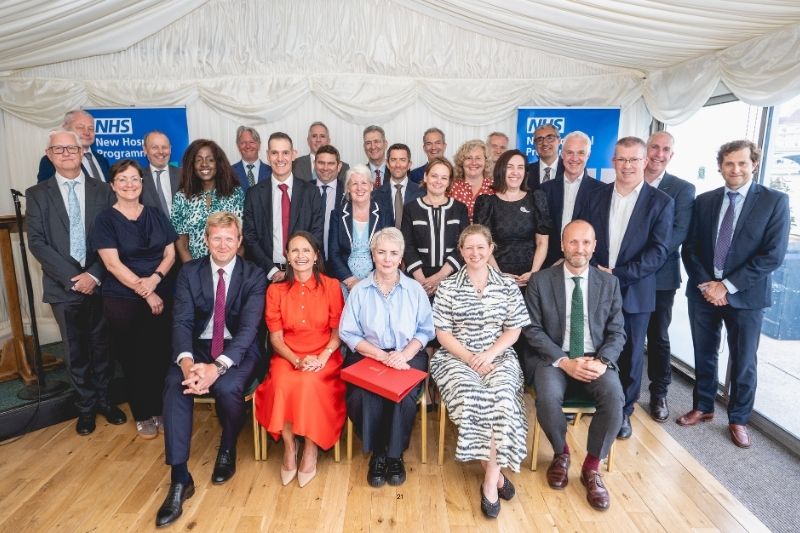
The New Hospital Programme is one of the NHS’s biggest capital programmes in decades, with plans to deliver 46 new and upgraded hospitals across England.
But turning those plans into reality requires more than a standard procurement exercise.
The programme spent two years engaging with the construction industry before launching its collaborative delivery model and £37bn framework, the “Hospital 2.0 Alliance”, after initially finding limited appetite in the UK for work of this scale and complexity.
Speaking exclusively to Building Better Healthcare, Alliance Director, Emma Whigham, reveals how that market engagement shaped the Alliance, and how the NHP is now trying to use its scale to change the way major NHS projects are delivered.
“We haven't delivered this level of hospital healthcare infrastructure for decades, and so we'd lost a degree of capacity and capability within the UK,” she said.
The programme therefore had to build the market as well as procure from it, engaging potential contractors before formal procurement began and looking internationally for organisations with major healthcare experience and an established presence in the UK.
Whigham said the strategy paid off.
With 10 construction partners now appointed and the first 11 schemes allocated, the Alliance is moving into delivery.
From 24 applicants, to 10 alliance partners, and one contract
The NHP received 24 applications, before reducing the field to 16 tenderers and moving into a competitive dialogue process for choosing the Alliance.
“We didn't think that we were going to get 24, so we were blown away with the level of engagement and enthusiasm for the programme but we clearly hit the right mark,” Whigham said.
The tender evaluation covered areas including hospital delivery experience, occupant safety, supply-chain management, innovation, digital capability and social value.
But Whigham said the distinctive feature was the dialogue with bidders, which allowed the NHP and contractors to agree to the commercial terms of the Alliance before individual hospital projects were allocated.
The 10 successful partners agreed a common framework agreement and model call-off contract, meaning the NHP did not subsequently have to negotiate 11 separate sets of core terms for the first schemes.
“What we haven't had to do is negotiate 11 different contracts because of the model call-off contract and the terms and conditions,” she said.
Those contractors now entering those individual contracts are on the same set of terms and conditions, and that is unprecedented.
The resulting group consisted of organisations capable of delivering schemes ranging from around £300m to projects approaching £1bn, alongside contractors bringing experience from both the UK and overseas.
But agreeing the terms was only the first part of the process.
Changing the path of traditional procurement
The NHP then took another unusual step.
Rather than running a separate competition for each hospital, it asked the construction partners which schemes they wanted to deliver.
Each was given a prospectus for the 11 schemes and held one-to-one discussions with the trusts.
Contractors then set out their preferences and the reasons for them, including geography, scale and complexity, while responding to standard questions that allowed trusts to carry out their own due diligence.
The NHP used that information to determine the optimum allocation across the programme, ensuring all 10 construction partners received at least one scheme.
Whigham said the approach also changed the nature of competition.
We've not eliminated competition entirely, but what we have done is fundamentally change where the competition happens.
Instead of contractors competing primarily to win individual projects, the Alliance is intended to make them compete on how effectively they deliver them.
“The competition is about delivering the very best hospital in the very best way,” she said.
That means innovations in construction methods, productivity, digital technology, AI, supply-chain management and industrialisation can be shared across the alliance rather than remaining with the contractor that developed them.
“Rather than focusing on a single outstanding scheme, we’re creating a programme of continuous improvement of hospitals that can learn from one another. Lessons will be captured and shared throughout design and delivery, supporting continuous improvement across the programme and ensuring every scheme, including those in later waves, benefits from the collective experience of the Alliance,” Whigham said.
Hospital 2.0 is also a supply-chain strategy
That continuous improvement model is closely linked to the NHP's push for standardisation.
The objective is not to build identical hospitals, but to standardise repeatable elements so that they can be delivered at scale and create cost-saving and reliable efficiencies.
Whigham said this could range from concrete frames and facade panels to whole standardised rooms and equipment.
The Hospital 2.0 full-scale prototype of a modular in-patient bedroom, complete with ensuite and corridor connection, is an example of a repeatable component that can be adapted and manufactured at scale across different hospital schemes.
Developed by off site construction specialist Reds10 last year, the prototype has since undergone design amendments following input from clinical and construction teams.
“If you wanted each hospital to have slightly different lengths, concrete frames, or the sizes of the facade panels were different, each time a manufacturer had that order, they would then have to readjust their manufacturing capability to be able to deliver that,” she said.
Greater standardisation could therefore allow suppliers to increase throughput and invest in manufacturing capacity with greater confidence.
That is particularly important given the wider shortage of infrastructure capacity and skills.
The Alliance is already looking at how more work could be moved off site, including areas such as mechanical, electrical and plumbing where workforce shortages are particularly acute.
The aim is to reduce workload pressure on individual hospital sites while creating more stable manufacturing employment that can support the wider infrastructure pipeline.
And the NHP sees that pipeline extending well beyond the first 11 schemes.
The programme's funding arrangements are intended to give supply chain certainty beyond individual projects, with capital secured for the first five-year cycle and expected to extend for a further 10 years, covering Waves 2 and 3.
Whigham said that visibility could encourage suppliers to invest in capacity for the longer term.
“The supply chain will start to invest in a 10-15 year pipeline that they wouldn't do if it was only two or three years,” she said.
That could mean investment in manufacturing processes, additional capacity, business growth and apprenticeships.
The programme has also begun bringing the wider supply chain into the model, looking at how lower-tier suppliers can respond to the repeatable components and longer-term pipeline.
The Alliance is also examining whether that investment and capacity can be coordinated across multiple projects rather than separately for each hospital.
Five hospitals in one region
The East of England, where five NHP hospitals are located, provides one example of how the NHP could use the concentration of projects to reduce duplication.
The NHP has invited suppliers in the region to a supply-chain event in Norwich on 17 September, where construction partners for the five schemes will outline potential supply-chain opportunities.
“What we’re looking at is how we can industrialise that and take some of the work off site, so that we’re not relying on having all of those people on every single site,” Whigham said.
The same principle could potentially be applied to other elements of delivery, with the Alliance looking at where shared resources and infrastructure could make more sense across several projects.
Two and a half months from framework to schemes
So far, Whigham said the new approach is proving a success.
Within 2 and a half months, the NHP went from framework award to allocating the first schemes.
Quite a lot of time contractors get onto a framework and then sit there for months on end without anything happening. It's definitely not been in that space, Whigham said.
Through the Alliance, the 11 schemes now entering contracts form part of the 16 projects in Wave 1, with five already underway.
Whigham said funding for the first-wave schemes is secured, although individual projects still require full business case approval before construction can begin.
What does this mean for wave 2?
The NHP is now working with its construction partners to identify future opportunities to accelerate detailed design and reduce project schedules.
That could create opportunities for some Wave 2 schemes to move forward earlier than originally anticipated.
Merging NHS England with the Department of Social Care
The Alliance is taking shape at the same time as NHS England is being merged into the Department of Health and Social Care.
Whigham said the transition should not fundamentally alter the NHP because the programme is already jointly operated by NHS England and DHSC.
The programme will therefore continue through the transition, as will be the case for all of NHS England, and its functions that will ultimately sit within DHSC once the legislative changes take effect.
The procurement itself has also been structured to accommodate changes in the public bodies responsible for the programme.
For Whigham, the priority is to avoid the organisational change distracting from delivery.
“As soon as those things are officially under the department, we'll just move the programme into that, and we'll just focus on delivery,” she said.
The next test for the New Hospital Programme
The next six to nine months will be critical in establishing whether the Alliance can deliver the benefits promised by the Hospital 2.0 model.
The NHP is now actively developing Alliance strategies for other aspects of its longer-term objectives, including using industrialisation, standardisation, continuous improvement and reducing duplication between projects.
That could mean looking at shared workforce, logistics or consolidation facilities across multiple schemes rather than each hospital developing its own arrangements.
The Alliance is also working with the NHP Industrialisation Team on opportunities for off site manufacturing.
But Whigham said the Alliance will ultimately have to demonstrate tangible results.
“The next six to nine months is about setting up the foundations to be able to deliver the tangible benefits,” she said.
I am very clear that the Alliance is not a talking shop. It is there to drive delivery value for every single organisation within it.
The NHP team will develop its first Alliance strategy to set out the long-term objectives and will continue to review it annually.
The first contracts may mark the end of the NHP's procurement exercise, but for the Hospital 2.0 Alliance they represent the start of a more difficult test: proving that a different way of procuring hospitals can translate into a different way of building them.
Featured companies



- Companies:
- Sir Robert McAlpine
- Willmott Dixon Ltd
- Vinci Building UK (VINCI Construction Management Ltd)
- Graham Construction
- Morgan Sindall Construction


