

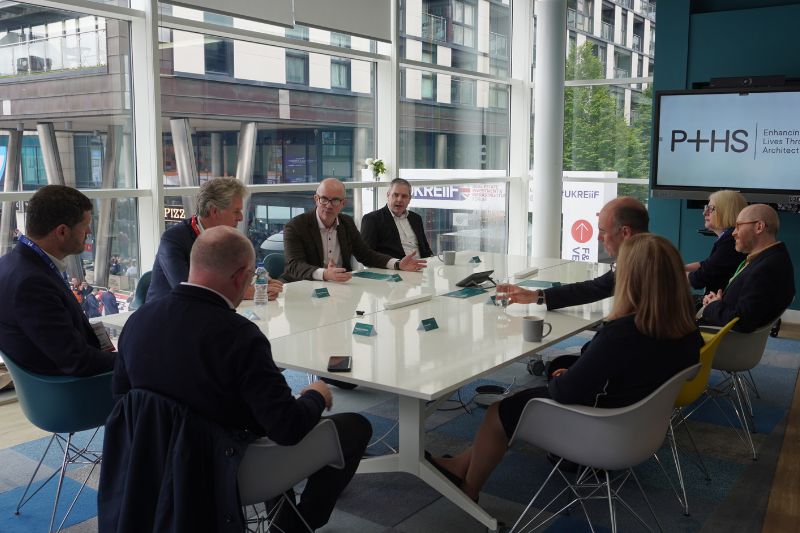
P+HS Architects and McAvoy recently hosted a roundtable discussion titled: From Capital to Care: Aligning Public and Private Investment for the Future of Healthcare.
The roundtable brought together nine senior leaders from McAvoy, Ridge, GB Partnerships, Sewell Advisory and Sir Robert McAlpine Capital Ventures to explore how future healthcare projects could be financed and delivered more effectively.
The event was held in P+HS Architects’ Leeds office, with hundreds of property professionals, investors, developers and senior decision-makers bustling outside along the canals to kick off the first day of UKREiiF, the UK’s forum for real estate, investment and infrastructure.
During the roundtable, the nine representatives debated the future role of private finance in healthcare, lessons from previous PFI and LIFT models, and whether current procurement and business case processes are slowing progress on urgently needed infrastructure.
How political uncertainty impacts healthcare project delivery
Opening the discussion, James Almond, Managing Director of P+HS Architects, spoke about mounting pressures to define how future healthcare projects would be funded and delivered amid growing demand for new neighbourhood health and hospital infrastructure.
Several attendees argued that financing itself was not the core barrier to delivery, but rather a lack of political certainty and consistent leadership.
“Delivering healthcare and building what’s needed is not about finance; it’s about political decisions to make it happen. Once that decision is made, then it’s about how you go about delivering it,” said Robert Wotherspoon, CEO of SRM.
He added that private finance could still play an important role in enabling projects to move forward while embedding long-term asset management disciplines.
Standardisation and flexibility in design: a balancing act
Much of the debate focused on the balance between standardisation and flexibility in healthcare design and delivery.
Drawing comparisons with education programmes such as Building Schools for the Future and the Priority School Building Programme, Hugh Robinson, who serves as Development Director at GB Partnerships, argued that standardised delivery models had previously generated significant efficiencies.
“You ended up with a great deal of efficiency driven out of that, much better value for money for the taxpayer,” said Robinson.
However, speakers repeatedly warned against overly rigid approaches that failed to adapt to changing healthcare requirements over time.
Wotherspoon noted that many earlier PFI schemes had been heavily influenced by individual project champions whose priorities later changed once leadership teams moved on.
“You need to keep that standardisation, so whoever comes in, it’s the right solution and flexible enough for change in the future,” he said.
Lessons from LIFT
During the roundtable, the longevity and adaptability of existing LIFT buildings were highlighted as one of the more successful aspects of previous public-private partnership models.
The Local Improvement Finance Trust (LIFT) programme was launched by the Department of Health in 2001.
The initiative was designed to replace crumbling, outdated GP surgeries with state-of-the-art, multi-purpose health and wellbeing centres.
The programme has driven over £2.5bn in capital investment, resulting in 350 facilities nationwide.
Rather than using standard Private Finance Initiative (PFI) methods, LIFT operates through 49 distinct local joint-venture companies known as LIFTCos.
The public sector, represented by the government-owned company Community Health Partnerships, maintains a 40% equity stake in the buildings, while independent private sector investors own the remaining 60%.
Emma Bolton, CEO of Sewell Advisory, said many older LIFT facilities remained in strong condition because they had been designed with flexibility in mind.
“There’s a reason now that the public sector is looking at purchasing 25-year-old assets,” said Bolton. “A lot of the stuff we do day in and day out now is variations to buildings that are in really good condition.”
Tom Potter, Associate Director at P+HS Architects, added that designing purely around the lowest upfront capital cost often undermines long-term building performance.
“The good thing about the LIFT buildings is that they were built for longevity and flexibility,” said Potter.
Several contributors also highlighted the role that standardised manufacturing and repeatable design principles could play in improving productivity and reducing costs.
Martin Harvey, Head of Design and Technical Services at McAvoy, said standardisation of design was “absolutely key” to improving efficiency across delivery and supply chains.
“If you have that basic grid or some basic fundamental standardisation, it’s not about standardising every room, it’s about the parameters,” he said.
The hurdles of the NHS business case approval process
Alongside questions of design and procurement, the roundtable also examined frustrations around the NHS business case approval process and the growing complexity of project governance.
Stephen Clayton, Preconstruction Director at McAvoy, warned that additional layers of assurance and bureaucracy were making projects increasingly difficult to deliver.
“There was another layer of bureaucracy put on top of things,” said Clayton, adding that projects were often subjected to repeated reviews and escalating information requirements before construction could begin.
Paula Atkin, Healthcare Planning and Estates Advisor at EDGE, defended aspects of the NHS business case process, arguing that public investment still required rigorous scrutiny and auditability.
“The business case process has always been a really lengthy process, but ultimately those business cases are a truly auditable process,” said Atkin.
Attendees broadly agreed that excessively long approval periods created significant risks around inflation, changing site conditions and evolving project scopes.
However, Robinson warned that the longer you make that business case process, the more the moving parts within it could possibly change.
The future of private financing models
The future of private finance models also remained a central theme throughout the roundtable, with participants suggesting that new forms of PPP delivery were likely to return due to ongoing public capital constraints.
Bolton said:
“We haven’t got the capital to do what we need to do without it.”
Paul Deverill, Head of PFI/PPP Strategic Advice at Ridge, stressed that the market needed greater certainty around future procurement structures before investment could accelerate.
“We need to be clear about what the vision is and what the model is,” said Deverill.
While views differed on how quickly progress would be made, most participants agreed that greater engagement between government, funders, designers, contractors and NHS organisations would be essential if future healthcare infrastructure ambitions were to be realised.
Closing the session, Almond said the industry remained united around the need to move projects forward despite ongoing uncertainty.
“We all want it to happen,” he said. “It’s just about making it happen.”
Featured companies

- Companies:
- Sir Robert McAlpine
- Community Ventures Management Ltd


