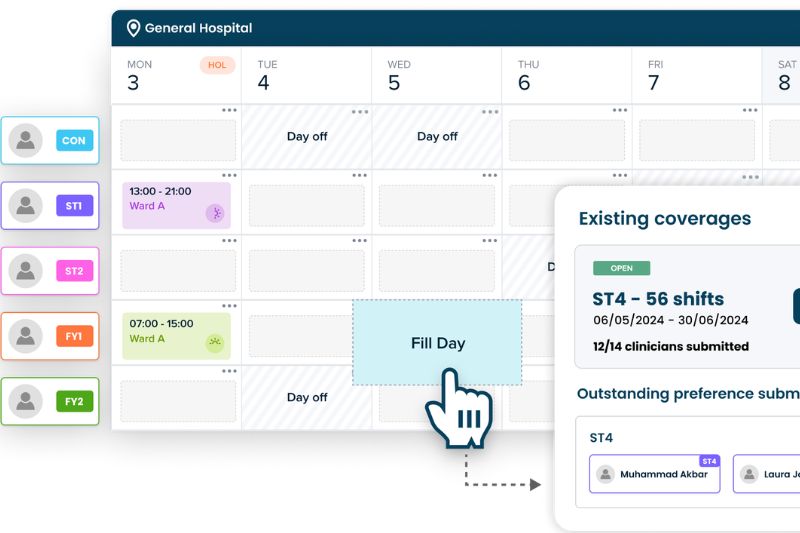


Patchwork Health has unveiled an AI-powered ‘preference-based rostering’ tool aimed at helping NHS organisations build compliant staff rotas while incorporating individual clinician preferences.
Developed by the doctor-led workforce management platform, the technology is already being adopted by NHS Trusts in England.
How does the system work?
The system uses a bespoke AI algorithm to process clinician shift preferences alongside service demand and workforce rules, generating flexible rosters in minutes.
Patchwork Health said the technology is designed to handle thousands of job-planning permutations, a task that traditionally requires days or weeks of manual adjustments.
According to the company, the platform factors in both positive and negative shift preferences, distributes night, weekend and long shifts, and ensures rosters meet compliance and minimum staffing requirements.
The aim is to provide clinicians with greater control over their working patterns while reducing administrative pressures on rota coordinators and management teams.
The launch comes amid ongoing workforce challenges across the NHS, including staff retention pressures and efforts to reduce reliance on temporary agency workers.
“Traditional rostering is a driving factor behind the NHS retention crisis, and the resulting spend on agency staff,” said Dr Anas Nader, Co-Founder and CEO of Patchwork Health.
According to Nader, the preference-based rostering is intended to address these issues by improving flexibility and reducing unfilled shifts.
Highlights from recent research about benefits
Recent findings from the Royal College of Physicians have highlighted persistent frustrations with existing rota systems.
In a survey, 38% of resident doctors described their rota software as easy to use, while 43% reported being unable to request leave before rotas were published.
Patchwork Health’s modelling suggests its AI-based approach can generate rosters that meet 98% of negative clinician preferences at the point of creation.
The company said this reduces the need for repeated manual revisions after publication.
Early trials of the system have also produced measurable operational outcomes.
In a comparison conducted on a single NHS ward over a 10-week period, Patchwork Health reported a 97% reduction in unfilled shifts when using Preference-Based Rostering.
Temporary staffing costs for the ward fell from £18,000 to £400, representing a 98% reduction.
Next steps on the rollout
Patchwork Health expects results from its first full NHS rollouts to be published later this year.
The company said these deployments will provide further evidence of the technology’s impact on workforce planning and service delivery.
Patchwork Health is currently partnered with over half of NHS Trusts and Health Boards across the UK.
More than 200 healthcare organisations, including Chelsea and Westminster Hospital NHS Foundation Trust, King’s College Hospital NHS Foundation Trust, Mersey and West Lancashire Teaching Hospitals NHS Trust, and North Cumbria Integrated Care NHS Foundation Trust, use its workforce management solutions.
The company said its technology has supported more than 120,000 healthcare professionals and contributed to over £180m in NHS staffing cost savings to date.