

Infection prevention and control (IPC) professionals, architects, clinical scientists, decontamination specialists, and healthcare estates leaders convened at the IPC Breakfast Forum hosted by Specialist Door Solutions (SDS) this month, issuing a clear and urgent message: infection control is too frequently treated as an afterthought in healthcare design and construction, and the consequences could cost lives.
The forum, bringing together decades of combined healthcare, scientific, and design expertise, concluded that poor IPC design does not just generate costly retrofit work, it creates invisible, untraceable risks that accumulate over years. Unlike a fire, a healthcare-acquired infection leaves no single moment of accountability.
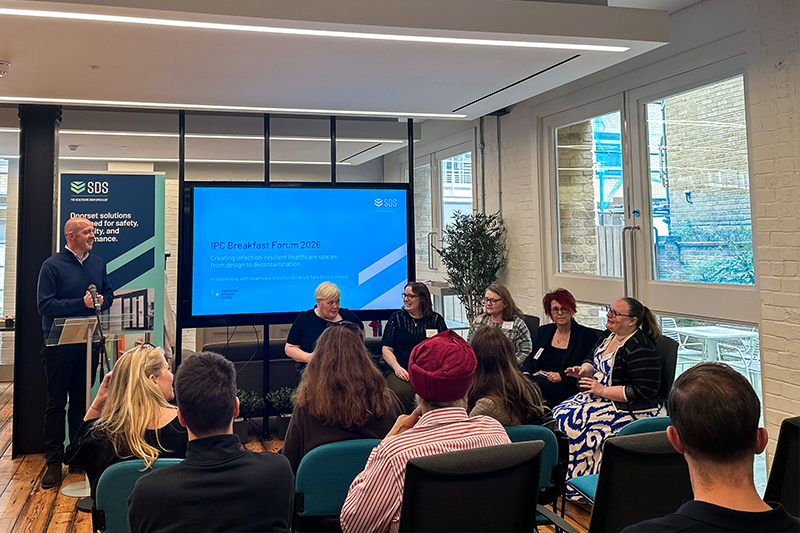
Key insights from the forum.
IPC must be involved from day one. The panel highlighted dramatic inconsistency across NHS Trusts in when or whether infection control specialists are engaged. Late involvement leads to rooms that are too small, ventilation systems that compromise fire compartmentalisation, and surfaces that cannot be effectively cleaned. The best outcomes emerge when IPC specialists, architects, engineers, and contractors collaborate from Stage 2 onwards.
Risk-based thinking must replace one-size-fits-all solutions. Different spaces, patient groups, and organisms require different approaches. Designing everything to the highest specification is unaffordable; designing too low creates risk. Rigorous, space-by-space risk assessment is essential, and the drive toward standardisation in the New Hospital Programme risks embedding IPC compromise at scale.
A critical competence gap must be addressed. Many specialist nurses may work on only one capital project in their career. Post-pandemic, significant numbers of experienced practitioners left the sector, creating a knowledge vacuum at the worst possible moment. The forum drew a direct parallel with fire safety: just as the Grenfell tragedy exposed the competence gap in fire compliance, the New Hospital Programme is exposing an equivalent gap in IPC expertise.
Lifecycle performance must drive design. Healthcare buildings operate 24 hours a day for 30 to 50 years. Yet design decisions are frequently made for day-one performance, with insufficient thought given to maintenance, replacement, and decontamination. Products that clean well on day one may fail after repeated exposure to clinical-grade agents, creating cracks and crevices where microorganisms can persist.
People and behaviours are as important as infrastructure. Cleaning staff, often under-trained, under-supported, and working from generic guidance, are the last line of defence against infection. Ward nurses are not trained cleaners. The forum cited the ‘Spotless’ scenario-based training programme as a model for how meaningful, behaviour-changing training can be delivered.
IPC and fire safety must be designed together. Door specifications, ventilation strategy, and fire compartmentalisation must be considered in parallel. Brush-type smoke seals present significant IPC risks in clinical environments. Derogations between competing compliance requirements must be resolved through documented, multi-disciplinary risk assessment, not by default.
Guidance frameworks are out of date. The Health Technical Memoranda and Health Building Notes (HTMs and HBNs) underpinning NHS design standards are widely considered obsolete and failing to reflect current clinical practice, emerging organisms, or modern construction. The forum called for a coordinated, centrally funded effort to update and maintain guidance, citing Australia’s live, single-platform model as an aspiration.
The HTMs and HBNs are what people are using as standards. If the guidance isn’t up to date, and the training isn’t there, we’re building new hospitals on an inadequate foundation.
Alyson Prince, Infection Control Nurse & Built Environment Specialist.
A generational opportunity, and a generational risk.
The forum closed with a shared sense of urgency about the New Hospital Programme. Eleven new hospitals represent an extraordinary opportunity to embed infection resilience at scale, and an equally extraordinary risk if lessons of the past are ignored.
The panel called on the sector to resist pressure to value-engineer IPC compliance out of specifications, drawing a direct comparison with fire safety, which cannot be compromised.
IPC specialists, architects, contractors, FM teams, and product manufacturers must be in the same room from Stage 2 onwards if the programme is to deliver buildings that are genuinely infection-resilient for decades to come.
We need to think about not just what looks great on day one, but what is safe on year ten. Those can sometimes lead to very different decisions.
Professor Elaine Cloutman-Green BEM, Consultant Clinical Scientist (Infection Control Doctor).
Download the IPC Forum summary paper.
If you would like to watch back a recording of the event or download the full summary paper from the IPC Breakfast Forum, please follow the link here.